Sunday, December 28, 2014

Liberty Records: Don't Give It Up

Just for fun, I decided to add another Liberty release to round out the week. In 1980, Capitol/EMI resurrected the label as a vehicle for the United Artists’ catalog that was purchased two years earlier. Making the transition from the UA brand that they were permitted to use for two years, Liberty became the official label for the catalog of releases that now were under EMI’s control.


Instead of managing Liberty from EMI’s flagship American brand, Capitol Records, it fell under the jurisdiction of EMI America for promotion. In addition to United Artists, Imperial, Liberty and other related labels’ catalogs released under the label, Liberty was EMI’s primary country music outlet.

Several of these artists had been previously signed with United Artists, such as Kenny Rogers, Dottie West, Cristy Lane, and the Nitty Gritty Dirt Band. While primarily a country and oldies imprint, a number of pop artists were signed to the reinvigorated label including Robbie Patton.

Having been an opening act for Fleetwood Mac, Patton was promoted as having a connection with these superstars. To further cement this connection, Christine McVie played keyboards and co-produced the “Distant Shores” album and the “Don’t Give It Up” single along with Ken Caillat and Robbie Patton. In addition, Lindsey Buckingham, Fleetwood Mac alumnus Bob Weston, and Tim Weston played guitars.

Backup vocals were supplied by McVie and another Fleetwood Mac alumnus – Bob Welch. Welch and McVie were also joined on backup vocals by Robin Sylvester who played bass on the track and by David Adelstein who also played keyboards. Although not on this particular recording, Stevie Nicks lent her vocals to another track.

While never a major success, Patton’s “Don’t Give it Up” charted in 1981 at #26 on the Hot 100 and #41 on adult contemporary chart. The song was co-written by Patton and Adelstein.


Saturday, December 27, 2014

Liberty Records: Power of Love

Before the Allman brothers were the Allman Brothers, they first The Allman Joys and then later The Hour Glass. Based out of Los Angeles, Gregg and Duane Allman (from The Allman Joys) and Pete Carr, Johnny Sandlin, and Paul Hornsby (of the Men-its) formed this pop band with a slight edge.


Through connections with the Nitty Gritty Dirt Band, who were under contract with one of Transamerica’s labels, United Artists, The Hour Glass were signed to another Transamerica subsidiary, Liberty Records. The band released two albums, “The Hour Glass” and “Power of Love,” and six singles – four of which were credited to Gregg Allman and Hour Glass.

In order to fulfill the band’s contract with Liberty, Gregg Allman recorded an album of material with session musicians that, outside the two single “A” sides, was shelved until some of the recordings were released the 1990s. Eventually all of this material, along with outtakes from the bands’ two official LPs, was released on CD by Acadia Records as “Southbound.”

While the originating two bands had both performed blues covers, Liberty attempted to mold The Hour Glass into a soul/pop band. Unfortunately, The Hour Glass never achieved the status they deserved and when they split in 1968, Duane and Gregg formed the Allman Brothers Band. The other three members headed back to Alabama where they became session musicians Fame Studios, one of the two prominent recording studios located in Muscle Shoals.

“Power of Love” was written by two Alabamans who also spent a great deal of session time at the studios in Muscle Shoals and later in Memphis: Dan Penn and Dewey “Spooner” Oldham. Penn and Oldham had coauthored a number of songs including “Cry Like a Baby” for The Box Tops and “I’m Your Puppet” for James and Bobby Purify. By the time “Power of Love” was written, Penn was already an established songwriter and producer.

Oldham had a plethora of hits under his belt having played organ on Wilson Pickett’s “Mustang Sally,” Aretha Franklin’s “I Never Loved a Man,” and Percy Sledge’s “When a Man Loves a Woman.” He was a member of the Muscle Shoals Rhythm Section that was nicknamed The Swampers along with Hour Glass alumnus Pete Carr. Oldham has played with numerous artists and was inducted into the Rock and Roll Hall of Fame as a sideman in 2009.

“Power of Love” features Gregg Allman on organ and lead vocals and Duane Allman on lead guitar. While it doesn’t measure up to the brothers’ later material, it is a decent enough recording. Unfortunately, it never charted and hence is truly a bubbling (way) under selection.


Friday, December 26, 2014

Liberty Records: Going Up The Country

It’s day six of our look at Liberty Records and we turn to Canned Heat’s highest charting single, “Going up the Country.” Credited to Alan “Blind Owl” Wilson, it was far from being an original tune. As with a number of the artists recording blues songs in the late 60s and early 70s, “Going up the Country” is an example of overt plagiarism – but, let’s call it what it is was – pure unadulterated theft.


“Going up the Country” is nearly note for note a copy of Henry Thomas’ 1927 recording of “Bull Doze Blues.” Although the melody is the same, the clincher is session musician Jim Horn’s flute parts. They are note-for-note identical to Thomas’ original accompaniment and lead. While Horn used a flute, Henry Thomas played the quills – an African version of the pan pipes. I would imagine that he had the quills attached to a rack so he could accompany himself while playing a guitar.

The similarities are so evident, the stars and the planets would have to be aligned just right and the odds of a billion to one would have to be stacked in Canned Heat’s favor to create this song without influence from Thomas’ original. On the surface, it appears that Wilson, who sang the song as well, just borrowed the tune from Thomas and created the lyrics.

Well, that’s partially true as he did write the lyrics, but he had some inspirational help from Johnny Miller who wrote “Up the Country ” in 1927 for Wingy Manone who recorded it twice: once in 1927 as “Up the Country” and then later in 1930 as “Up the Country Blues.” Wilson’s lyrical content is original, but it is obvious that he heard Manone’s recordings and borrowed the idea for the title and the hook lyric.

Recorded for Canned Heat’s “Living the Blues” album in 1968, the single was released in late November 1968 and charted in 1969 at #11. The band performed “Going up the Country” at Woodstock. In the film, the studio version was used while the actual Woodstock performance was included on the soundtrack album.


Henry Thomas’ “Bull Doze Blues”


Check out the musical similarities between Canned Heat’s hit and this 1927 recording. Despite that the label says whistling, Thomas was actually playing the quills. 


Wingy Manone “Up the Country”


Not the original US 1927 release, but a later UK reissue.

The title and hook lyric were “borrowed” from this 1927 recording. Manone’s unusual nickname came about because he lost an arm in a streetcar mishap.


Thursday, December 25, 2014

Liberty Records: A Not So Merry Christmas

One of Liberty Records’ biggest stars of the early ‘60s was Bobby Vee; however, his music was filled with stories of bad relationships. Notwithstanding, Bobby struck a chord with the record buying public. Maybe it was his boyish good looks, his smooth voice, or possibly consumers identified with the content of his message.


And let’s take a look at his message. Consider “Take Good Care of My Baby” and “Run to Him” – he was giving his gal up to some other guy without an argument. At other times, he wasn’t quite sure of the stability of his partner or his relationship status; think of “Devil or Angel” and “The Night Has a Thousand Eyes” – with the latter tune implying that Bobby was a stalker.

On another occasion, he is the constant rebound lover in “Rubber Ball” – there to always pick up the pieces when an old girlfriend ends a relationship with another guy; he would later become a victim. To heap coals on the fire, just remember “Please Don’t Ask about Barbara.” Finally, there’s “Come Back when You Grow Up” girl. Let’s not even go there.

Do we see a theme developing? This guy keeps chasing the women away. Today’s Christmas selection is no better, as Bobby was planning to have “A Not So Merry Christmas.” Unable to repeat the mirth of the previous holiday season, the sad “A Not So Merry Christmas” leads off the second side of the “Merry Christmas from Bobby Vee” album, which was released in December 1962. Vee is backed by The Johnny Mann Singers on all of the cuts.


Actually, “A Not So Merry Christmas” would have made a great Christmas single, as it modeled Vee’s formula hits. Originally, Liberty had intended issuing it as a 45, but shelved that idea, as “A Night Has a Thousand Eyes” was released the day after Thanksgiving 1962. A Christmas single would certainly erode sales of this up-and-coming hit record and in essence, Bobby would be competing with himself – and we see what happens when he competes with other guys – he loses.

Since the “A Night Has a Thousand Eyes” LP would not hit the stores until April 1963, the release of a Christmas album fit into Liberty’s overall marketing schema. Unfortunately, the release only charted at #136. While 13 of his 25 albums never made the charts, “Merry Christmas from Bobby Vee” had the third worst position of the 12 that had placed on Billboard’s Top 200 Albums chart. Be that as it may, “A Not So Merry Christmas,” even with his characteristic sad undertone, is still a classy tune. Here’s wishing that you have a better Christmas than Bobby Vee did in 1962.


Wednesday, December 24, 2014

Liberty Records: Quiet Village

Today’s selection is not very Christmassy (if that’s a word), but after spending 20 years in radio, you tend to get burnt out on Christmas music very quickly. There’s only so much of a hit and run reindeer, mommy kissing Santa Claus, the lack of two front teeth, Alvin, and back bacon one can take. To satisfy the insatiable Christmas fans, I promise a Christmas release tomorrow from Liberty Records, no doubt – and Ross Bagdasarian had nothing to do with it.


For today, the musical style is exotica. Martin Denny, the father of the genre, was also a Liberty recording artist. He and his band discovered their unique sound while playing at the Shell Bar in Hawaii. When the band played, the local frogs croaked. When they stopped playing, the frogs stopped as well. As a gag, some of the band members decided to do bird calls during the performance. The next night, the owner asked them to do the song with the frogs and birds again – and exotica was born.

The signature tune of the genre was Denny’s adaptation of Les Baxter’s 1952 song “Quiet Village.” They recorded it in 1957, but since there were no frogs present, Denny used a makeshift güiro from a grooved cylinder. In 1959, Liberty Records decided to release “Quiet Village” as a single and it shot up the charts to the #4 position. It also crossed over to the R&B chart where it peaked at #11.


For the album “Exotica,” the beautiful model Sandy Warner graced the cover. In fact, Warner was the face of Martin Denny’s albums for the next eleven releases as well. I always loved this song and was able to purchase the original single release with a stock Liberty sleeve in 1976 in mint condition at a little music store in East Jenkins, KY. I think I paid a quarter for it.

It was the second time I visited this now extinct establishment and I always walked away with collector items including a rare Beatles album that I paid $2.00 for in 1973. Its current worth is between $600 and $800. The value of the “Quiet Village” single – not so much, and it is probably valued in the $15 range – still worth a lot more than I paid for it nearly 40 years ago. Enjoy this Wordless Wednesday selection from Liberty Records.


Tuesday, December 23, 2014

Liberty Records: Cry Me A River

Since I featured Joe Cocker’s version of “Cry me a River” last night, I thought I might divert my Liberty Records’ selection today to the original recording. I hadn’t planned on any Julie London songs for this week, but with the circumstances with the death of Joe Cocker, I thought it might be nice to hear the version that Cocker probably heard first and inspired him to make it his own.


Arthur Hamilton wrote “Cry me a River” in 1953 originally for Ella Fitzgerald to sing in the movie “Pete Kelly’s Blues” – and she did; however, her recording was cut from the film and shelved until 1961. After others passed on the tune, Julie London recorded it and the original release became the sixth single issue for Liberty Records in 1955. It appeared on her second album, “Julie is her Name.” Hamilton had one of the more unusual lyrics in this hit, as he wrote, “Remember, I remember all that you said. Told me love was too plebeian – told me you were through with me and . . .”

Backed with a Spartan accompaniment from Barney Kessel on guitar and Ray Leatherwood on bass, it was all that was necessary to provide a platform for London’s low, sultry voice. Charting at #9, it was her signature song as no other Julie London single made it into the Top 40 let alone the Hot 100. In the UK where Joe Cocker would have heard the song, it only charted at #22. No one, including Joe Cocker, has ever matched Julie London’s chart performance of this tune on either side of the Atlantic.


Movie Video


Although Ella Fitzgerald’s recording laid on the cutting room floor, Julie London’s rendition made it into several movies. It has appeared in “Passion of Mind” and “V for Vendetta,” but another film provides a unique haunting version of “Cry me a River.” London sang the complete number in the 1956 release of “The Girl Can’t Help It.” In the clip, Julie appears as an apparition to Tom Ewell’s drunken character Tom Miller. Was it the paranormal or the DTs? We may never know.


Monday, December 22, 2014

Cry Me A River as Joe Cocker Has Departed

I don’t often have two posts in a day, but when I do it is usually due to unfortunate news. Earlier today, I heard that 70 year-old Joe Cocker had succumbed from lung cancer. His death occurred in Colorado where he made his home. In 1968, he was propelled into the spotlight with his rendition of The Beatles’ “With A Little Help from my Friends.” While it was a number one record in Britain, it had a dismal showing in US where it only peaked at #68.


His appearance on the stage of Woodstock gained him further notoriety and he entered the Top 40 charts in the US. Some of his biggest hits included the following:
  • His rendition of another Beatles’ album cut, “She Came in through the Bathroom Window” that charted at #30,
  • A cover of The Boxtops number one record from 1967, “The Letter,” that reached #7 in 1970;
  • A rocking version of the 1950s torch song “Cry Me a River,” at #11;
  • His composition with keyboardist Chris Stainton, “High Time We Went,” that charted at #22;
  • A live re-issue of Dave Mason’s “Feeling Alright” that landed at #33. This version did significantly better than the 1968 studio rendition that charted at #69;
  • His cover of the Allman Brothers’ “Midnight Rambler” that landed at #27;
  • His most popular solo release that charted at #5 – “You are so Beautiful”;
  • A duet with Jennifer Warnes, “Up Where We Belong,” which became his most popular recording and was his only #1 record; and
  • His final Top 40 hit in the US, 1989’s “When the Night Comes.”

Although I am not featuring “Up Where We Belong,” I have a personal connection with this song. As the music director at WCIR-FM in Beckley, WV, I was one of the first programmers in the country to play the record on the air. It was immensely popular in our market; however, it took awhile for other stations to play the tune and for several weeks only a handful of reporting stations had added the song. My gut instinct was correct, and the record peaked at #1 for three weeks. It also won the both the Academy Award and the Golden Globe for “Best Original Song.”

Atlantic Records, who was distributing Island Records at the time, promised me a gold record if it sold a million copies. Unfortunately, the record sold slightly under a million and initially failed to have gold status. With sales of it as an oldies release, the Recording Industry Association of America certified the single both as gold and platinum in January 1989. By December that same year, the single was reissued; however, it failed to chart in the US the second time around.


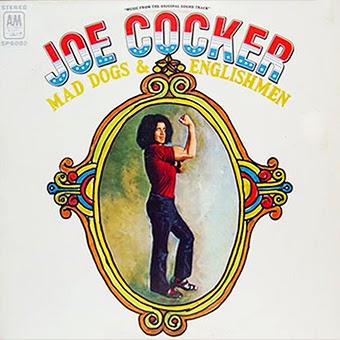
While I am not featuring this tune, I have decided to feature his rocking rendition of the torch ballad “Cry me a River.” Recorded live at the Fillmore East in New York in March 1970, “Cry me a River” was originally a slow tempo, sultry number until Cocker got a hold of it.


The album features a veritable who’s who of the music business. Most notably, Leon Russell is on piano, Don Preston on guitar, and Chris Stainton is playing a Hammond organ. This is a great recording and captures Cocker’s energy. I’ve never had the opportunity to see him live, but have seen his Woodstock footage as well as other videos – and he was the consummate (and very animated) performer. We’ll miss you Joe – Rest in Peace.