Showing posts with label Thursday's Repeats and Threepeats. Show all posts

Thursday, June 25, 2015

Stiff Records: Hooked on Love

As I said during our first post chronicling Stiff Records, the label’s biggest hit in the US was Ian Gomm’s 1979 classic “Hold On” that I featured several years ago as a “one hit wonder.” While Gomm was signed to Stiff/Epic in North America, Stiff was not his UK record label – that was Albion Records who was distributed in the UK by Arista. In a number of other countries, Gomm appeared on Arista’s sister label Ariola and on Victor in Japan.


Although not released as a single in the UK on Albion, it was Gomm’s second US single and follow-up to “Hold On.” Additionally, it was the second cut on his first US album “Gomm with the Wind.”    


Billboard in November 1979 gave a glowing review of the single by stating, “Bright uptempo rocker reinforced by driving percussion and crisp horn flourishes make this an excellent followup [sic] to ‘Hold On.’ Clean harmonies and modulations in the arrangement underscore the hook.” Unfortunately, Billboard’s comments fell on deaf ears and “Hooked on Love” failed to make it into the Hot 100 or even the “Bubbling Under” category.


Billboard mentions the song’s modulations – and there are two. The tune starts in the key of “C” and modulates to “D.” Just before the fade, it modulates again to “E.” This is a great little song with a swing beat, but alas the modulations were not enough to carry this tune. Again with CBS doing the promotion as this was a Stiff-Epic release, they may have had other Epic and Portrait artists that they were pushing harder at the time. So goes the music business.


Brinsley Schwarz Original

Americans who had the opportunity to hear Gomm’s recording of “Hooked on Love” were first exposed to this song in 1979. Gomm’s former band, Brinsley Schwarz, recorded the song first in 1973. “Hooked on Love” appeared as the lead track on the band’s LP “Please Don’t Ever Change.”


It also shared the B-side of the single “Country Girl” with “Surrender to the Rhythm” that was released in 1978. Unfortunately, United Artists decided not to release either the album or the single in the United States – probably due to their lack of a following here. The 1978 release of the single might have been in response to Brinsley Schwarz members Nick Lowe and Ian Gomm’s solo careers that were just starting.


I attempted to find a studio version of the original, but couldn’t. We will have to settle for a very nice live rendition by Brinsley Schwarz that was from the “Old Grey Whistle Test” presumably in 1973 or ‘74. Their version was slightly slower, had only one modulation from “C” to “D” and has a bridge that is missing from Gomm’s solo version.

In addition, there are no “horn flourishes,” but rather some nice Hammond B3 work by Bob Andrews. Note, Nick Lowe is present on bass – another Stiff artist in the UK, but alas he was signed to Columbia in the US and we will not be featuring his music this week. Pity – maybe some other time.

Thursday, March 12, 2015

The Many Shades of Leon Russell: The Ballad of Mad Dogs & Englishmen

One of several things that increased the visibility of Leon Russell was his impetus in being the music director for Joe Cocker’s “Mad Dogs & Englishmen” tour. Russell assembled the band, which were a veritable who’s who of session and backing musicians. Recorded in March 1970, the corresponding double album was released in August of that same year. Russell played piano and guitar and provided vocals.


A documentary of the tour was filmed in October 1970 and was later released during March 1971. “The Ballad of Mad Dogs & Englishmen,” a somber remembrance of that year’s tour, was recorded by Leon Russell in 1970 for the movie’s closing credits. It is an autobiographical treatment of Leon’s memories of the tour.


The song was issued twice by two different labels. It was released first as a single on A&M and later as an album cut on the album “Leon Russell and The Shelter People” on Shelter Records. Outside of piano and vocal by Russell, the only other instrumentation is the moving string arrangement scored by Nick De Caro.


Friday, January 30, 2015

Smash Records: The Sun Ain't Gonna Shine (Anymore)

Occasionally, when I’ve looked at specific labels, I discover that a single song was released a number of times by different artists. Such is the case with today’s selection “The Sun Ain’t Gonna Shine (Anymore).” Written by the hit producing songwriting team of Bob Crewe and Bob Gaudio, the initial version was recorded by The Four Seasons, but was released under Frankie Valli’s name on the Smash Records label.


As a member of the band, Gaudio sang and played keyboards and Crewe, who produced a plethora of Four Seasons’ hits, reprised this role on the original recording of “The Sun Ain’t Gonna Shine (Anymore).” Although Crewe and Gaudio had written a number of hit songs like “Big Girls Don’t Cry,” “Walk Like A Man,” “Ronnie,” “Rag Doll,” “Bye Bye Baby (Baby Goodbye),” “Silence is Golden,” “Can’t Take My Eyes off of You,” and others; Frankie Valli’s version of “The Sun Ain’t Gonna Shine (Anymore)” wasn’t one of them. The original version had a dismal showing at #128.


But Valli’s version of the tune was not the end of its run. In 1966, another Smash artist would have greater success with the song. Although The Walker Brothers hit number one with “The Sun Ain’t Gonna Shine (Anymore)” in the UK, it peaked at #13 in their native United States.


While none of The Walker Brothers were actually named Walker and they certainly weren’t brothers, their greater success was due to their successful attempt at an American invasion of Britain at the height of the British invasion on this side of the Atlantic. It has been rumored that The Walker Brother’s fan club in England was larger than The Beatles’ fan club membership in Britain. I’m not so sure I believe this; but if it were so, it would have been quite an honor for this trio of Yanks from Los Angeles. By the way, all three Walkers continued to use the surname personally and professionally long after they disbanded.


Thursday, November 27, 2014

Vee Jay Records: Thank You Girl

Happy Thanksgiving and today’s selection is the reason I picked Vee-Jay Records as our fourth week label feature. “Thank You Girl,” which was originally titled “Thank You Little Girl,” was an effort for The Beatles to thank their female fans. They hoped that each of these young ladies would consider the song as being a personal message of gratitude. The recording featured John Lennon on double tracked lead vocals and Paul McCartney on the high harmony. Additionally, it was the first recording by group to feature double tracked vocals. The song took 13 takes to complete and features harmonica overdubs by John Lennon.


The Beatles’ “Thank You Girl” appeared as a flip side on not one, but two Vee-Jay single releases by The Beatles. When Capitol Records passed on The Beatles in 1963, the masters of their first album, “Please Please Me” in the UK, were leased to Chicago based Vee-Jay Records. Prior to Beatlemania hitting America by storm in 1964, Vee-Jay released two singles: “Please Please Me”/”Ask Me Why” and “From Me to You”/”Thank You Girl.” The latter was released in the US on May 6, 1963. Since The Beatles were yet an unknown commodity in North America, “From Me to You” only charted at #116.

Once the floodgates were opened with the #1 release of “I Want to Hold Your Hand” on Capitol,” Vee-Jay began ramping up their Beatles product and beat Capitol to the punch with the first American Beatles’ LP, “Introducing The Beatles,” on January 10, 1964. Capitol followed with “Meet the Beatles!” ten days later.

Although the album titles and covers were different, “Introducing The Beatles” and “Please Please Me” had much in common including track order. There was one major difference; the UK version had more songs. Like all of the UK releases through “Revolver,” “Please Please Me” was no exception, as it contained two additional cuts that were eliminated from the American release. “Please Please Me” and “Ask Me Why,” which had been previously issued in early 1963 as the first Beatles’ Vee-Jay single, were not on the initial release of the album.

As Vee-Jay was trying to quickly capitalize on the new found fame of The Beatles before their license expired, “Introducing The Beatles” was repacked several times. The first reissue replaced “Love Me Do” and “P.S. I Love You” with “Ask Me Why” and “Please Please Me.” This was due to a restraining order from Beechwood Music, Capitol’s publishing arm, who had not licensed these two songs yet in the US.


During 1964, Vee-Jay issued other albums featuring the material from “Introducing The Beatles.” These included “Jolly What! England's Greatest Recording Stars: The Beatles and Frank Ifield on Stage” (which was later repacked as “The Beatles and Frank Ifield on Stage”); “Songs, Pictures and Stories of the Fabulous Beatles”; “The Beatles vs the Four Seasons”; and an EP, “Souvenir of Their Visit to America.” The two versions of the Beatles/Frank Ifield album was misleading as all of the tracks were studio recordings – four by The Beatles and eight by Ifield.

Additionally, Vee-Jay flooded the market in 1964 with additional Beatles’ singles. These included the following:
  • “Please Please Me”/“From Me to You,”
  • “Ask Me Why”/“Anna” (promo only),
  • “Twist and Shout”/“There’s A Place” (on Vee-Jay subsidiary Tollie Records),
  • “Do You Want to Know a Secret”/“Thank You Girl,”
  • “Love Me Do”/“P.S. I Love You” (on Vee-Jay subsidiary Tollie Records),
The second release of our feature tune was as the “B” side to “Do You Want to Know a Secret.” This single was released on March 23, 1964 and did quite well as a double sided hit. “Do You Want to Know a Secret” peaked at #2, while “Thank You Girl” made it to #35.


The record was certified gold for sales in excess of a million copies. Because Vee-Jay was overwhelmed in pressing Beatles’ records, numerous label variations exist for all of the releases. The one shown above is a Tollie yellow blank used for this particular issue. Black blanks, also used for Tollie releases, were used as well.


To make one last stab at sales before Vee-Jay’s license expired in October 1964, the label issued four Vee-Jay/Tollie singles on their subsidiary Oldies 45. “Do You Want to Know a Secret” and “Thank You Girl” were issued with the lowest catalog number of the four simultaneous releases.

True Stereo Version

While the Vee-Jay issues were either mono or rechanneled stereo, a true stereo version of “Thank You Girl” was issued by Capitol on “The Beatles’ Second Album,” which was released on April 10, 1964. In addition to being a true stereo mix, this version of “Thank You Girl” contains additional harmonica parts during the song’s bridge and at the end.


Capitol added extra reverb to the vocals its North American album release of “Thank You Girl.” To me the reverb is a bit over-the-top considering that the wet signal was in a different channel than the dry signal, and that sounds a bit odd at times. Since this was a different mix, Capitol may have sidestepped Vee-Jay’s rights to the song.


Following the expiration of Vee-Jay’s license, eleven of the songs from “Introducing The Beatles” were issued by Capitol on “The Early Beatles” in March 1965. One year following Vee-Jay’s last minute issue of four singles on their Oldies 45 label, Capitol issued six singles by The Beatles in their Starline Series of oldies singles.


While in the 70s and 80s, all of The Beatles’ singles were issued with the Starline imprint, these six releases were the only Starline Series Beatles’ records in the 1960s. Similar to the standard yellow/orange Capitol swirl label, the original Starline Series releases were in a two-tone green swirl.

Of the 12 songs released on the Starline label, 10 of these had appeared previously as Vee-Jay recordings. While the first four had the same configuration as the Oldies 45 singles, two additional singles were issued: “Roll over Beethoven”/“Misery” and “Kansas City”/“Boys.” If you notice on the Vee-Jay releases, the songwriting is credited to McCartney-Lennon rather than the more common configuration of Lennon-McCartney that was used thereafter.

The song fulfills several duties today.  Because it is an expression of thanks, we make it our Thanksgiving holiday song.  It also charted in the 30s, so it is our Thirty Something Thursday release.  Finally, since it was released multiple times, it fits the bill as our Thursday's Threepeats and Repeats selection. Hope you enjoy both versions. 


Thursday, April 24, 2014

Bang Records: Shilo

When Neil Diamond had recorded, “Just for You,” his second and final album for Bang Records in 1967, he urged Bert Berns to release one of his new recordings, “Shilo,” as a single from the LP. Preferring to issue more pop oriented songs as singles, Berns refused even though Diamond persisted because he felt that “Shilo” epitomized his growth as a songwriter.


“Just for You” contained two tracks that also appeared on Diamond’s first album “The Feel of Neil Diamond.” Both cuts, “Solitary Man” and “Cherry Cherry,” had been released also as singles in 1966. No doubt their inclusion on the new album was a ploy to boost sales of “Just for You.”


“Just for You” is an uncanny LP, as all eleven tracks ended up being an “A” or “B” side of a Bang single.

The single releases from “Just for You” included the following:
  • B-519 “Solitary Man”/”Do It” – April 1966 #55
  • B-528 “Cherry Cherry”/”I’ll Come Running” – July 1966 #6
  • B-536 “I Got the Feelin’ (Oh No No)”/”The Boat that I Row” – October 1966 #16
  • B-540 “You Got to Me”/”Someday Baby” – January 1967 #18
  • B-542 “Girl, You’ll Be a Woman Soon”/”You’ll Forget” – March 1967 #10
  • B-547 “Thank the Lord for the Night Time”/”Long Way from Home” – July 1967 #13
  • B-556 “Red Red Wine”/”Red Rubber Ball” – March 1968 #62
  • B-561 “Shilo”/”La Bamba” – September 1968 – did not chart
  • B-575 “Shilo”/”La Bamba” – January 1970 #24
  • B-578 “Solitary Man”/”The Time is Now” – July 1970 #21
  • B-586 “I’m A Believer”/”Crooked Street” – June 1971 #51
  • B-703 “The Long Way Home”/”Monday Monday” – June 1973 #91
In addition to these, three other Diamond tunes were culled for single releases during this same period:
  • B-551 “Kentucky Woman”/”The Time is Now” (non album single) – October 1967 #62
  • B-554 “New Orleans”/”Hanky Panky” (from the first LP) – January 1968 #51
  • B-580 “Do It”/”Hanky Panky” (from the first LP) – October 1970 #36

Shilo – Version One (September 1968)


While “Shilo” eventually was released as a single, it was after Bert Berns’ death. Issued in September 1968 after Diamond had moved over to Uni Records, “Shilo” was as Berns had predicted.


In 1968, the world was not ready for the more esoteric Diamond tune about an imaginary friend; consequently, it was his only Bang single that never made it into the Hot 100. “Shilo” was produced by Diamonds Brill Building songwriting friend Jeff Barry.


Shilo – Version Two (January 1970)


When Uni had success with two Top 10 Diamond singles in 1969 (“Sweet Caroline” and “Holly Holy”), Bang reached back into the vaults and rerecorded the backing tracks to match Diamond’s current style.


This time Bang had a hit with the remixed version of “Shilo.” It charted at #24 in 1970. Although it is also in the original version, listen for the toy piano in this release of “Shilo.” A perfect addition for a song about an imaginary childhood friend. Everybody had one - my friend’s name was unusual as well - it was “Corn.”


Bang repacked the material and added the new version of “Shilo” and released a new compilation with the hit single as its title track. The new version was produced by Jeff Barry and his wife Ellie Greenwich - both Brill Building regulars.


Shilo – Version Three (October 1970)


With “Shilo” doing fairly well for Bang, Uni felt that it couldn’t be outdone and Diamond reentered the studio and re-recorded “Shilo.” This third version was then added to a re-release of Diamond’s 1968 Uni LP “Velvet Gloves and Spit.”


For this 1970 album reissue, Uni released the album with a new cover that prominently announced that “Shilo” was on this particular LP. In my opinion, the Uni version has the superior mix. Additionally, another 70s version of “Shilo” appeared on Diamond’s 1972 live album “Hot August Night.”


These three studio versions of “Shilo” provide our Thursday Repeats and Threepeats selection along with our fourth week feature of Bang Records.

Thursday, March 27, 2014

Geffen Records: A Million Miles Away

Although formed in 1978 and having recorded for two nationally distributed labels (Planet and Geffen), the band would only have one near miss: “A Million Miles Away.” In fact its appearance in the movie “Valley Girl” and its subsequent popularity spurred the band to rerecord “A Million Miles Away” for their only album on Geffen – “Everywhere but Once.”


Not only am I featuring the song as part of my series on Geffen Records it is also my Thursday Repeats and Threepeats selection, as “A Million Miles Away” was originally released on the independent label Shaky City Records in 1982. The single was issued in both 7 and 12 inch versions.


The popularity of “A Million Miles Away” intensified as the song was included in the movie “Valley Girl” where the band appears to be playing it live. Because of this attention, The Plimsouls rerecorded it for inclusion on “Everywhere but Once.” Released in 1983, “A Million Miles Away” placed at the #11 spot on the album radio charts; however, it failed to generate much interest from the mainstream public. Its dismal peak during the summer of ‘83 was at #82 on the Hot 100 chart.

I loved this song and played it as an album cut at WCIR in Beckley, WV; however, it failed to gain any momentum in our market. Prior to disbanding, the band released one further single: “Oldest Story in the World.” By 1984, front man Peter Case was a solo artist and his excellent debut album was also released by Geffen. These two albums were the sum total of Case’s and The Plimsouls’ contributions to David Geffen’s empire.

The Plimsouls’ sound probably had many influences, but one that comes to mind when listening to “A Million Miles Away” is The Byrds. The 12-string electric guitar and the licks that sound like Roger McGuinn’s work are a dead giveaway. Chances are you’ve never heard this cut by The Plimsouls, and if you had, it’s been nearly like “A Million Miles Away.”


Thursday, March 20, 2014

The Guess Who: No Time

When I was doing last week’s tribute to “Daylight Savings Time,” I originally considered using The Guess Who’s “No Time” for my Thursday Repeats and Threepeats feature; however, I decided to go with a song that’s title began with the word “time” to match my other features.


The Guess Who recorded and released “No Time” twice with slightly different arrangements and mixes. The original version appeared as the lead track for the 1969 album “Canned Wheat.” This version is faster, is longer, sports a unique intro, has different guitar parts, and the vocal mix is different from the later version.


The earlier recording was not released as a single from “Canned Wheat,” as RCA chose “Laughing,” which radio also flipped and played “Undun,” giving The Guess Who a double-sided hit. Unhappy with the original versions of these two cuts, the band rerecorded “Laughing” and “Undun” at Phil Ramone’s A&R Studios for the single release. The album includes the updated versions and not the originals taped earlier at RCA with the rest of the cuts on “Canned Wheat.”


Later in 1969, the band re-recorded “No Time” for their next album: “American Woman.” The shorter version was picked to be the debut single of the album and the new mix proved to be popular with radio and the record buying public.


“No Time” was released in December 1969 and charted at #5 in early 1970. Most people will agree that the mix on this version is superior; however, the original has some interesting guitar work from Randy Bachman. Speaking of Bachman, the “American Woman” album was his last with The Guess Who before he formed Brave Belt with former Guess Who lead vocalist Chad Allen. Brave Belt later morphed into Bachman-Turner Overdrive.


Thursday, March 13, 2014

Daylight Savings: Time Has Come Today

Day four of our second week feature and this month’s specific tribute is to Daylight Savings Time. Since it is also a Thursday, we have a double honor of providing a song that was released three times for our Thursday’s Repeats and Threepeats feature. The Chambers Brothers may have introduced the world to the concept of psychedelic soul with their recording of “Time Has Come Today.”


As I mentioned, the song was released three times with the initial version from September 1966 being a unique recording of the tune. It is faster and a bit different than the later hit version of the song – the differences are especially noticeable with the guitar parts in the intro and during the short instrumental break. In addition, it had a unique catalog number of 4-43816 while the two later editions of the song were both issued by Columbia as 4-44414. The flip side of the 1966 release was “Dinah.”


When the band recorded their album “Time Has Come Today” in 1967, they laid down a new 11 minute version of the tune; however, radio would never play a song that length, so Columbia edited the single down to 3:05 for release on the day after Christmas. Unimaginably, they faded the song at the first instrumental break. Like the original version from a year earlier, version two flopped.


Columbia believed in this record, so after the dust settled, a second edit of the new version at 4:55 was issued in July 1968. It proved the old adage that the third time was a charm. It was released with the same flip, their impression [get it] of Curtis Mayfield’s “People Get Ready,” and the same catalog number.


The 1968 rendition was their first top 40 hit making it all the way to #11 where it stayed for five weeks. This was a true edit of the long version and it proved to be the key to the song’s success. While The Chambers Brothers had one other Top 40 hit with their follow-up “I Can’t Turn You Loose,” “Time Has Come Today” is considered their magnum opus.


One can’t feature this classic psychedelic soul cut without including the entire 11 minute version of this classic ‘60s cut. Enjoy all of the interesting tidbits of this recording including the heavy use of reverb, the two cowbells doing a tick-tock sound, strange tempo changes, fuzz guitar, electric sitar, screams, laughs, wolf howls, and Martin Denny type bird calls. To top it off, there’s a bit of “The Little Drummer Boy” in the middle of the song. Makes you wonder what they were tripping on the day they recorded this tune.


Thursday, February 27, 2014

Uni Records: Border Song

In April 1970, the “Elton John” album was released in the US and it subsequently peaked on the Billboard album charts at #4. Not bad for an artist who was unknown in the US until this release. John’s first album from 1969, “Empty Sky,” would not reach North American audiences until 1975.


While Elton John was signed to Dick James Music (DJM Records) in the UK, the label attempted to make a dent in the US in 1968. DJM even released Elton John’s first US single: “Lady Samantha”; however, it failed to chart.

Seeing some potential in John, MCA picked up his North American option and initially released two singles on Congress before moving him over to the higher profile Uni Records. Congress originally was a subsidiary label of Kapp and both labels had come under Uni’s control in 1967.

In addition to another unsuccessful release of “Lady Samantha” in March 1970, the second Congress single, “Border Song,” was issued the following month and it too received a chilly reception. Re-released in July 1970, “Border Song” peaked at #34 in Canada; however, this gospel tinged ballad only made it to #92 in the US.


Holy Moses! Even at #92, it did better than it did in Elton John’s native land, as it failed to chart in the UK. The last verse, which was written by Elton John and not by lyricist Bernie Taupin, indicates that the song is about bigotry.

I love the production on these early Elton John albums – as they had a rich and full sound. Paul Buckmaster’s arrangements have always been appealing. Boy, I haven’t listened to this LP in a long time – I need to get it out more.


Thursday, January 30, 2014

Sire Records: Hocus Pocus

If you took Deep Purple, Ian Anderson, an Alpine yodeler, Popeye the Sailor, Frankie Yankovic, and Whistling Jack Smith and had them compose one song, you might come up with “Hocus Pocus.” Dutch band Focus’ signature tune had it all – a heavy rock band that had flute, yodeling, scat singing, accordion, and whistling all on one track.


I remember this record quite well. It was the summer of 1973 and I just graduated from high school and got my first car. My friends and I would spend the evenings cruising through the eastern suburbs of Pittsburgh listening to the radio. My ’64 Ford Fairlane 500, however, only had an AM radio with one oval speaker, but that was sufficient to hear the tunes in all of their mono glory. That summer, it seemed that the three Steel City Top 40 stations (13Q, KQV, and WIXZ) only played three songs: “Smoke on the Water” by Deep Purple, “Frankenstein” by the Edgar Winter Group, and “Hocus Pocus” by Focus. These three cuts dominated the airwaves.


Released in the US on Sire Records, “Hocus Pocus” – in all of its unusual glory – made it to the Top 10 and charted at #9. It also was the first record I ever purchased on the Sire label. The flip side of the single was part two of the nearly seven minute album cut from their “Moving Waves” LP. The song was born with a riff created by Jan Akkerman while the band was practicing in a room of a castle that they had rented as a rehearsal hall. 

While coauthor Jan Akkerman’s guitar shines on this number, the real work came from the song’s other author, Thijs Van Leer, who played the organ, accordion, and flute along with whistling, singing the Popeye like scat parts, and of course yodeling – the song’s unique characteristic. Typically it categorized as an instrumental, but Thijs Van Leer considers it a vocal performance; albeit, a different type of vocal performance.

The song also fits our Repeats and Threepeats category as the album was released three times and the single twice. Generally known for the album’s second and third releases distributed by Polydor and Famous Music as “Moving Waves,” the original version of the album was named “Focus II” and was on Sire distributed by Polydor.

The single was released twice in succession from Polydor and Famous Music Corporation. Interestingly enough, the two issues had the same catalog numbers; however, the publishing companies were listed with different identities. I was cognizant of the two issues at the time and sought out a copy distributed by Polydor as it would be rarer.

Even though Nike used it for a World Cup commercial a few years ago, you don’t hear “Hocus Pocus” much these days as the novelty  has worn thin, but it is always a treat to hear the band’s only American Top 40.


Thursday, January 23, 2014

Manfred Mann's Earth Band: Spirit in the Night

Just as Manfred Mann in the 1960s recorded several songs by Bob Dylan, Manfred Mann’s Earth Band in the 1970s chose to record three songs penned by Bruce Springsteen. Released under three different titles, Springsteen’s “Spirit in the Night” was issued twice as a single for Manfred Mann’s Earth Band with two different vocalists.


In 1975, the album “Nightingales and Bombers” listed the tune as “Spirits in the Night.” Mick Rogers was the vocalist on this version as well as for the first single release in 1976. The single listed the correct title of “Spirit in the Night.” This first version charted at #97.


In 1977, Manfred Mann re-released a remix of the single featuring Chris Thompson on vocals. Thompson joined the band in 1976 and replaced Rogers. This single release featured the abbreviated title of “Spirit.” The second time around the song barely made it into the Top 40 by charting at the #40 position.

The singles, issued under different numbers, featured unique flipsides. One of the interesting aspects of the two singles is that the phonodisc (p) copyright for the 1976 version has a 1976 date; however, the copyright for the 1977 version is 1975 and lists their UK label of Bronze Records' logo, which is absent from the first single. Unfortunately, I could only find the Mick Rogers rendition and would have liked to feature his and Thompson’s version for comparison purposes.


Thursday, December 26, 2013

Chess Records: Many Rivers To Cross

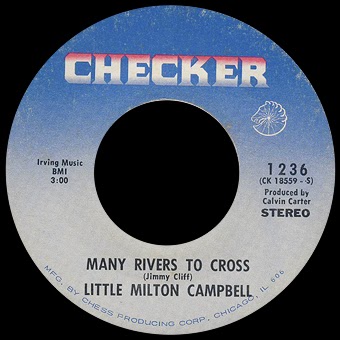
Although Jimmy Cliff wrote and recorded his magnum opus “Many Rivers to Cross” in 1969, his version failed to make a dent in the US and UK charts; however, today, his rendition is the one for which most people are familiar. Within a year of Cliff’s release, James Milton Campbell (AKA Little Milton) recorded probably one of the first covers of the tune.


Little Milton came to the stable of Chess recording artists first as an independent record label owner of Bobbin Records which was distributed by Chess subsidiary Checker Records. He later translated back as an artist for Checker where he released a number of singles including his version of “Many Rivers to Cross.”


This recording is perfect for a Thursday Repeats and Threepeats selection, as Little Milton’s version of this song was reissued as a single in 1976. The occasion was the release of All Platinum Records’ Chess Blues Master Series. Not only was this series a shot in the arm for the label, it brought back a number of Chess artists to public light in the mid 1970s.


Besides Little Milton, the series included Howlin’ Wolf, Muddy Waters, Lowell Fulson, J.B. Lenoir, Little Walter, Sonny Boy Williamson, and Jimmy Rogers. Each album had a unique cover by the same artist and they really make a nice collection. Unfortunately being a starving college student, I had to wait until the albums were cut out and I only got three of the series – one being Little Milton’s collection.


More of a soul and R&B artist rather than a strict bluesman, I found Little Milton’s inclusion in the series a refreshing alternative. I was not familiar with Milton’s recordings before this as he had limited Top 40 airplay. Only two other artists had greater success with the song than Little Milton and Jimmy Cliff: Nilsson recorded the tune in 1974 and his version peaked at #109 and Annie Lennox charted at #80 in 2008.

Although many others have recorded the “Many Rivers to Cross,” I prefer Little Milton’s soulful rendition of this classic. Incidentally neither issue of Milton's recording charted.


Thursday, December 19, 2013

The O'Jays: Christmas Ain't Christmas

For our Thursday Repeats and Threepeats, we provide a song that was issued five separate times: The O’Jays’ “Christmas Ain’t Christmas New Years Ain’t New Years Without the One You Love.” Like many Christmas songs, it failed to chart during any its five releases. Written by Kenny Gamble and Leon Huff, this holiday classic by The O’Jays was issued on three separate labels owned by composition/production duo.

In 1969, the single appeared on Neptune Records #20 paired with “There's Someone (Waiting Back Home)” on N-20. During the following year, it appeared on Neptune N-33 backed with “Just Can't Get Enough.”


By 1973, the same configuration appeared on Philadelphia International Records #ZS7 3537. This was repeated on Philadelphia International #ZS8 3581 in 1975 and in 1980 on TSOP Records as #ZS8 3771.


In 1975, Philadelphia International was rebranded as TSOP. This was largely due to the success of the #1 instrumental hit TSOP (The Sound of Philadelphia) by MFSB in 1974. In addition, Philadelphia International was involved in a payola scheme in 1975, so rebranding also helped distance the label from its legal troubles.

Produced by Gamble and Huff, “Christmas Ain’t Christmas” was arranged by veteran Philadelphia musician Thom Bell. It is an example of the Philly Sound made popular by Gamble and Huff’s stable of artists.


Thursday, December 5, 2013

The Viscounts: Harlem Nocturne

Back in May, I mentioned that only a handful of songs made the hair to stand up on the back of my neck. One of these was the haunting version of “Harlem Nocturne” by the instrumental rock ‘n roll band The Viscounts. It has particular significance in the movie adaptation of Stephen King’s “Christine,” as it plays during the first time you see the ‘57 Plymouth named “Christine” supernaturally rebuild herself.


Written in 1939 by Earle Hagen and Dick Rogers, The Viscounts took the tune to the Hot 100 chart in 1959. Unfortunately, it only made it to the #52 slot when it was originally issued on the small private Madison Records label.


Seven years later, Amy Records re-released the single for a modicum of success. Barely scratching the surface of the Top 40 in 1966, “Harlem Nocturne” peaked at the #39 position.

Starting with Joe Spievak playing fifths on his bass guitar, the key to “Harlem Nocturne’s” eerie sound is actually the slow speed amp tremolo used on Bobby Spievak’s guitar. To add to the effect, Spievak strummed the guitar backwards at the beginning of the piece and occasionally during other parts of “Harlem Nocturne.”

Following a crescendo on Clark Smith’s crash cymbal, the song’s mystique is punctuated by Harry Haller’s gritty tenor sax. Listen closely and you might be able to hear Larry Vecchio on organ deep in the mix; however, I haven’t been able to confirm it is present as of yet. Good stuff from The Viscounts, but I must retire to comb the hair on the back of my neck.


Thursday, November 28, 2013

Janus Records: Hey Gyp (Dig The Slowness)

Since we are in the midst of our Fourth Week Special that features recordings on the Janus Record label, I could not find a song dealing with thankfulness to be appropriate with the American Thanksgiving holiday. Although there were several songs released by Janus that fit this theme, none are available on YouTube. With that quandary, I’ve decided to revert to our typical Thursday Repeats and Threepeats special.


In 1966, Donovan’s “Hey Gyp (Dig the Slowness)” was released on the Hickory label in the US. A product of Pye Records in Britain, the label didn’t have an American outlet and Pye contracted initially with Hickory and later Epic Records to release the early Donovan recordings.


By 1969, Pye had invested in Janus Records and the label became their de facto American arm. When the contract with Hickory expired in 1970, the Hickory recordings reverted to Janus and the new label re-released several of the Hickory singles and a compilation of the Hickory material as “Donovan P. Leitch.” In addition, Janus repacked Donovan’s further 1965-66 material into 1971’s “Hear Me Now” before Pye sold their interest in Janus to GRT. After that, Pye contracted with Bell Records to further repackage the early Donovan material.

So for the short window of 1970-1971, Janus had the rights to all of Donovan’s early material. Of these releases, Janus reissued the “Hey Gyp” single in 1970. Like the 1966 Hickory release, the 1970 reissue failed to chart. Unlike Donovan’s later recordings with Epic, the 1965-66 material on Hickory and later Janus were sparsely produced. “Hey Gyp” and the other recordings from this era only featured Donovan on guitar, harmonica, and vocals with no other supporting musicians.

The “Gyp” in the song was inspired by Donovan’s best friend and road manager Gypsy Dave Mills. Part of the song’s failure to chart may be due to the title of the song. Neither “Hey Gyp” nor the parenthetical title of “(Dig the Slowness)” appeared in the lyrics. Titling the song “Just Give Me Some of Your Love” may have made all of the difference in the single’s sales and airplay – during both of its runs.


Thursday, November 21, 2013

Joe Cocker: Feeling Alright

Written by Dave Mason, he recorded “Feelin’ Alright” on Traffic’s self-titled second album and later on his solo LP “Headkeeper.” Although both versions received a modicum of album rock airplay, neither was destined to be a hit. Traffic’s single went as high as a whopping #123 and Mason’s solo version was never issued in a 45 format. Beginning in 1969, other musicians took their hand at making the song a hit.


Joe Cocker released his version in 1969 and it stalled at #69. Later that same year, Mongo Santamaria barely squeezed into the Hot 100 at #96. By 1971, the song was resurging with Grand Funk’s showing at #54; however, the highest charting version came in 1972 when A&M Records decided to re-release the single with the same catalog number. It finally broke the Top 40 and went to #33.

Most of this attention can be attributed to album radio playing the live version of “Feeling Alright” from Joe Cocker’s “Mad Dogs & Englishmen” LP. By having a mastered single version of the tune from the LP “With a Little Help From My Friends, A&M quickly met the public’s need for a 7 inch version of this tune.

Unlike Traffic’s and Mason’s versions of the tune, the “G” in the title was not dropped and was released as “Feeling Alright” as opposed to “Feelin’ Alright.” Session musicians contributed to Cocker’s hit and included Artie Butler on piano, Carol Kaye on bass, David Cohen on guitar, Paul Humphrey on drums, and Laudir de Oliveira on congas, cabasa, and vibraslap. Backup vocals were supplied by Merry Clayton and sisters Brenda and Patrice Holloway. Good stuff from Joe Cocker.


Thursday, November 7, 2013

Vanilla Fudge: You Keep Me Hangin' On

It is said that Vanilla Fudge’s cover of The Supremes’ “You Keep Me Hanging On” was recorded in one take; however, it took two times on the charts for their version to become a hit in its own right. A 2:50 edit of a seven minute album cut was originally released in June 1967 and immediately stalled at #67.


Believing in the potential of the band, ATCO Records re-released the single in June 1968 and the second time around it peaked at #6. The first release titled the song as "You Keep Me Hanging On" while the second release correctly rendered the title with the dropped "G."


While it seems unusual for a psychedelic band like Vanilla Fudge would record this tune as their first single, but drummer Carmine Appice explains the rationale:

In 1966, when I joined the band, there was a thing going around the New York area and Long Island that was basically slowing songs down, making production numbers out of them, and putting emotion into them . . . We were all looking for songs that were hits and could be slowed down with emotion put into them. “You Keep Me Hangin’ On” lyrically was a hurtin’ kind of song, and when The Supremes did it, it was like a happy song. We tried to slow down the song and put the emotion the song should have into it with the hurtin’ kind of feeling the song should have [had].

The Supremes released their version in October 1966 and it skyrocketed up both the Hot 100 and the R&B charts to the top position on both. Vanilla Fudge’s first release of the single was probably positioned too close to The Supremes’ version for it to be taken seriously.

By 1968, enough time had elapsed and Vanilla Fudge’s heavy sound was much more palatable to the record buying public. The tune was authored by Motown staff writers Eddie Holland, Lamont Dozier, and Eddie Holland who composed numerous hit records for Barry Gordy’s enterprise.


Album Version


Thursday, October 17, 2013

Billy Vera & The Beaters: At This Moment

It’s been a busy couple of weeks and I took a well needed rest from the blog for the first part of this week. Now, I am raring to go with a Thursday Repeats and Threepeats selection. Many folks will remember Billy and Beaters’ live recording of “At this Moment” appearing twice on the scene, but only the discerning record collectors will know about three releases of the single.


“At this Moment” was issued originally on the Japanese owned Alfa Records label in 1981 as the follow-up to Billy and the Beaters’ “I Can Take Care of Myself,” which narrowly made the Top 40 charts at the #39 slot. The ballad “At this Moment” wasn’t nearly successful and it tanked at #79. Both singles had been recorded live earlier in the same year at The Roxy in Los Angeles.

While I played both songs at WCIR-FM in 1981, the fact that Alfa Records did not have a strong presence in the US probably kept the singles from doing any better than their respective positions. Billy Vera and his 10 piece band wandered off of the charts until – until, that is, the TV show “Family Ties” started playing “At This Moment” on several episodes during its 1985-86 season.


The television airplay rekindled immediate interest in the song and Rhino Records licensed the masters for re-release as a single in October 1986. It’s originally flip side was “Peanut Butter”; however, within a month, Rhino replaced the flip side with “I Can Take of Myself” and issued the third single of “At this Moment” under the same catalog number as the second.

The cross media exposure had a profound effect, as “At this Moment” charted at the #1 slots on the Hot 100 and Adult Contemporary charts. It stayed at the #1 position for two weeks on the Hot 100 in late 1986. The song was produced by Jeff Baxter of Steely Dan and The Doobie Brothers' fame.