While focusing on blues and rhythm and blues, Chess Records was also one of the premier gospel labels in the 1950s and 1960s featuring a number of artists that would reach greater fame. The gospel releases spilled over to Chess’ subsidiaries of Checker Records and Cadet Records.
On Checker alone, 82 gospel singles and 57 gospel albums were released between 1953 and 1970. According rock historian Ed Ward, these recordings are difficult to find: “If you want to hear them . . . you'll have to go find the records. Gospel has never sold well, and it was the lowest-priority item for labels when the great reissue boom that the CD started came along.”
One of the premier gospel recording acts that made their mark on several labels, including Checker, were The Soul Stirrers. They may be the longest, continuously operating vocal group, as they formed in 1926 and are still performing today. A group with that length of tenure is also plagued with numerous personnel changes. The Soul Stirrers provided a proving ground for several artists including Sam Cooke and Johnnie Taylor.
When The Soul Stirrers moved to Checker, Johnny Taylor, who had replaced Sam Cooke in 1957 would remain year before embarking on his solo career. “Don’t You Worry,” our Spiritual Sunday release, was the ninth single for The Soul Stirrers recorded for Checker and the lead track for their 1969 album, “The Judgment.”
“Don’t You Worry” was penned by Leonard Caston, Lloyd Webber, and Sonny Thompson. Thompson also provided the arrangement and Ralph Bass produced the single. Bass, who was later inducted into the Rock ‘N’ Roll Hall of Fame in 1991 as a non-performer, also composed the single’s flip side, “When the Gates Swing Open.” The Soul Stirrers were inducted into the Rock ‘N’ Roll Hall of Fame in 1989 as early influences of rock ‘n roll.
This last Tuesday, May 8, 2016, renowned record producer George Martin passed away at the age of 90. As most news outlets reported, Martin was best known in his role as the producer of all of The Beatles hit albums save one – “Let it Be.” Although Martin had produced most of the album’s singles and was the original producer on the fledgling album under the working title of “Get Back,” the band replaced him with Phil Spector for the final album release.
During the next week, I’ll be highlighting Martin’s production work. Yes, we’ll be featuring a Beatles’ song or two, but I want to concentrate on some of the other artists he produced. While his work with The Beatles stretched his creativity beyond comprehension, he is one of the best known producers of the 20th century.
One of the groups that he worked with was Ultravox in 1982. This new wave synth band of the 70s and 80s was barely known in the US. Charting at #61, their best selling US LP, “Quartet,” was the only album produced by George Martin. As the band was preparing to record “Quartet,” they sought a new producer and Martin’s daughter Lucy, an Ultravox fan, encouraged her dad to take the gig.
One of the single releases from “Quartet” was their tune “Hymn.” Loosely drawing from biblical language, the band produced what would be best termed as a psalm or song rather than a hymn despite the record’s title. The artwork for the picture disc and the single’s sleeve used Masonic emblems– go figure. While “Hymn” was the band’s fourth most popular release in the UK and charted at #11, it failed to make a dent in the US charts. Ultravox’s only single to chart on the Hot 100 was “Quartet’s” previous single “Reap the Wild Wind,” which only made it to #71.
Enjoy this week of George Martin production and remember this man behind the music.
While I’ll admit my posts have been sparse during the past six months, but for a number of reasons I’ve had two posts on one day – yesterday and I will have a second one later today. Since today is Pastor Appreciation Day, I thought I might sneak in a song that is fitting for the moment: “I am the Preacher” by the The Derek Lawrence Statement.
As far as I know, this was the first recorded version of the song and it was released two months later by Deep Purple as their fifth American single. Their version of the song was titled “Hallelujah (I am the Preacher). It was written by Roger Greenaway and Roger Cook – two professional songwriters who penned a number of hits during the late ‘60s and early ‘70s.
In 1969, Greenaway sent a demo to Derek Lawrence – the producer of the first three Deep Purple albums. Lawrence didn’t think the band would be interested in the song, but he sent it to Ritchie Blackmore anyway. At this time, Deep Purple was seeking another lead singer, another bassist, and unbeknown to Lawrence, another producer.
While Purple’s version failed to chart in the UK, it did poorly in the US by peaking at #108. While Rod Evans was out of the band having been replaced by Ian Gillian, Nick Simper apparently played on this single as Roger Glover had not yet joined the band. Although Derek Lawrence supplied Deep Purple with the demo, they did not utilize his services as producer.
Tony Edwards and John Colleta, managers of the band, are listed as the producers. To my knowledge, it’s the only cut where Edwards and Colleta were cited in this capacity. They are listed on the UK single on Harvest Records, but not on the US version on Tetragrammaton Records. Subsequent recordings have listed the band as producers. You can check out Deep Purple’s version with a number of their other early recordings on this 2010 post of “Deep Purple before Smoke on the Water.”
Although Deep Purple just barely charted with the song, they did not have the first recording of “Hallelujah (I am the Preacher)” – Derek Lawrence used his bevy of studio musicians and vocalists to produce his outstanding single under the name of The Derek Lawrence Statement. Along with its flipside, I believe that this was the only release by The Derek Lawrence Statement; however, the group in various forms recorded under about a half a dozen different names for Lawrence. “I Am the Preacher” was released in May 1969, which was two months before Deep Purple’s rendition.
The powerful vocals of The Derek Lawrence Statement are provided by Larry Steele, Liza Strike, and Tony Wilson. I believe each take a turn at the lead vocals. They are joined by Albert Lee on lead guitar, Harvey Hinsley on rhythm guitar, Chas Hodges on bass, and drummer Micky Burt.
The Derek Lawrence Statement still lives as it has been sampled for four hip-hop recordings. They include Qwel and Meaty Ogre’s “The Fourth Reich of the Rich” from 2006, Dilated Peoples’ “Hallelujah” from 2014, Fel Sweetenberg’s “Tomorrows in the Stars” from 2014, and Brock Berrigan’s “The Preacher” from earlier this year.
For our fourth week label feature, I’ve decided upon Kama Sutra Records. With the aid of Art Kass, Kama Sutra Productions entered the recording business in 1964. The label was distributed by MGM Records until it joined with Buddah Records in 1969, which was owned by the same principals.
Although founded in 1967, Buddah began handing the distribution of Kama Sutra and a number of other labels in 1969. The last release with the Kama Sutra imprint was issued in 1976. This week, we’ll look at the 11-year run at this classic independent label.
For our first song on Kama Sutra, we head back to 1971 when the Canadian gospel rock band Ocean released their debut single: “Put Your Hand in the Hand.” Written by fellow Canadian Gene MacLellan, “Put Your Hand in the Hand” was first recorded by another Canadian, Anne Murray, who released the song on her third LP for Capitol, “Honey, Wheat, and Laughter.” Her previous hit single “Snowbird” had also been penned by MacLellan.
Initially, “Put Your Hand in the Hand’ was not released as a single by Anne Murray. Capitol saw the potential for this song, and in late 1970, country artist Beth Moore released the first single featuring the tune. Her version failed to make a dent in the country charts with a dismal showing at #61. Thinking that perhaps Murray could do better, Capitol released Murray’s version of the single in the US, but not in her native Canada. Murray’s stab did worse, as it peaked at #67 on the country charts.
With two failures with MacLellan’s tune, Ocean tried their hand (get the pun) at the tune and had a colossal hit. While it peaked in Canada at #10 on the Yorkville label, “Put Your Hand in the Hand” was a Top 5 hit in the US for Kama Sutra. While it topped the charts in Record World (remember this trade publication?), it additionally charted at #2 on Billboard’s Hot 100 and at #4 on the A/C charts. With the exposure of Ocean’s version of the tune, a number of other artists also recorded this now classic.
Last month, I attempted to feature Leon Russell during the second week of the month. Unfortunately after the first two posts, I contracted a dreaded gastrointestinal virus that put me out of commission for three days and in a state of weakness for the remainder of the week. With Leon Russell being the last thing on my mind, I forfeited our feature and planned to resume it in March. We are at that point and I have planned seven days filled with the “Many Shades of Leon Russell.”
Although Russell had be recording for at least a decade as a session musician and had released several recordings with others and had a few non-charting singles on his own, his solo career didn’t really begin until the release of his debut album in 1970.
The working title of this LP was “Can a Blue Man Sing the Whites?”; however, even though the album was advertised under that name, I do not think that it was released under that title. It was the first release for Shelter Records, which at that time was distributed by Blue Thumb Records. Russell’s album was the only one distributed by Blue Thumb before Capitol took over the manufacture and distribution of Leon and Denny Cordell’s label.
For today’s feature, I’ve selected the song “Prince of Peace.” The idea of the song is that you better treat an individual like you want to be treated, because that person might be “the Prince of Peace returning.” Although not a gospel song per se, it does have a spiritual meaning – and hence, I am categorizing it as a Spiritual Sunday selection as well. It’s a perfect addition to our look at the Many Shades of Leon Russell.
On Thursday, January 8, gospel music great Andraé Crouch shuffled off this mortal coil and into the arms of his Savior. A catalyst for the contemporary Christian music scene, Crouch was not only an excellent musician, but he was a prolific songwriter. Many of Crouch’s compositions reached legendary proportions with first his own recordings of these songs, but also for the hundreds of cover recordings and their appearances in numerous hymnals and song books.
I had the opportunity to meet Andraé back in 1973 or 74 at the Huntington (WV) Memorial Field House. He was the first star I would have the pleasure to meet, and I still have the program with his autograph. Unfortunately, it is boxed away and finding it these days is next to impossible – but I saw it when we were packing before our last move. He was generous enough, however, to stay as long after the show as necessary to meet every one of his fans.
Groomed as recording artist by Ralph Carmichael, Crouch’s talent was as big as life itself and is illustrated by seven Grammys, six Dove Awards, and numerous other accolades he was accorded. Crouch wasn’t perfect, but he was forgiven. Unfortunately for us, he died five days after suffering a heart attack. He was 72.
Although bassist Bili Thedford sang lead on Crouch’s composition “My Tribute,” it is still a fitting song to remember Andraé’s contributions to Christian music. “To God be the glory for the things He has done.” Rest in peace, Andraé.
Well, we have one more day in November, so I thought I’d extend our look at Vee-Jay Records one more time. Like its cross town rival Chess, Vee-Jay also signed a number of gospel artists in addition to its cadre of blues and R&B artists. One of those acts was The Staple Singers. While Vee-Jay wasn’t their first label (that was United) and it wasn’t the label of their greatest success (that would be Stax), this family band had a modicum of notoriety when they were with Vee-Jay.
One of their top sellers at the label was the 1956 recording of “Uncloudy Day.” As with most singles in the 50s, the song was released both as a 78 RPM single and as a 45 RPM single. Eventually, the 78 market diminished and was overtaken by 45 RPMs as the medium of consumers’ choice for a variety of reasons – but primarily for fidelity reasons.
“Uncloudy Day” features Roebuck “Pops” Staples and his four children: Cleotha, Purvis, Yvonne, and Mavis. “Pops’” guitar, with the amp’s tremolo turned up, is the sole instrument on this recording. “Uncloudy Day” is a loose adaptation of Josiah Alwood’s 1885 composition “Unclouded Day.” Over 90% of the original’s lyrical content is missing and the arrangement is as far away from the original as possible. This truly is a Staples’ song, by and by.
One of Judy Collins biggest hits was an unlikely choice to make it to the top 15 – the traditional hymn by John Newton – “Amazing Grace.” Although a popular choice of Christian congregants, the song amazingly (pun intended) hit the top 15 twice in the early 1970s. Both versions were unique.
In 1972, the Pipes and Drums of the Royal Scots Dragoon Guards and their bagpipe instrumental peaked at #11. Judy Collins’ a cappella version, which was akin to Joan Baez’s performance at Woodstock a year earlier, peaked at #15 in 1970. During the same period, Rod Stewart and Aretha Franklin both recorded “Amazing Grace” – neither charted.
Collins’ love affair with “Amazing Grace” began when she was a member of an encounter group in the 1960s. At the end of each meeting, the group sang the only song which everyone had known the words – “Amazing Grace.” To Collins, the song was a culmination of a long line of protests of the Vietnam War. After doing all she could to end the war, nothing was left but to sing “Amazing Grace.” And that she did.
Using the vocal talents of a group of friends, Collins recorded the song at St. Paul’s Chapel at Columbia University in New York City. The venue was selected because of its excellent acoustics. Although the song did extremely well in the US, it charted eight times in the UK between 1970 and 1972. The highest position was at #5.
It’s the second week of the month and I always try to come up with a theme to play across seven days of posts. I came up with today’s selection back in May and have dubbed it “In Search of Iain Matthews.” Born as Iain Matthew McDonald, he has performed as Ian McDonald, Ian MacDonald, Ian Matthews, and finally as Iain Matthews. I took the name of this week’s special in honor of his band Plainsong’s LP “In Search of Amelia Earhart.”
Matthews got his start with a West Coast/surf sounding band called Pyramid in 1966. The band released one single in 1967, “The Summer of Last Year” backed with “Summer Evening.” A third cut, “Me about You,” was eventually released in 1999. While Pyramid’s non-charting single “The Summer of Last Year” is available on YouTube, the sound quality of that recording is not the best; therefore, I won’t be providing it as an example.
We will, however, be featuring some of Matthews’ better recordings (in my opinion) from his first decade of performance. Matthews still performs today and my brother had an opportunity to open for one of his Pittsburgh shows a number of years ago. While not generally known by the hoi poloi, Matthews’ voice is unmistakable and needs to be heard more often – that’s my mission this week.
Today, we feature a trio of songs that appeared on Plainsong’s 1972 release “In Search of Amelia Earhart.” While only three songs on the album dealt with “The First Lady of the Air,” the title was inspired by Fred Goerner’s theory that Earhart was captured by the Japanese on Saipan. According to Goerner’s theory, Earhart’s first mate Frederick Noonan was beheaded and Earhart died of dysentery during her capture. It was theorized that Earhart and Noonan were actually on an air reconnaissance mission to spy on the Japanese for the US government.
It was hard picking one of the three songs that appear sequentially on the Plainsong LP, so I created a YouTube playlist that features all three Earhart related tunes. The first was Plainsong’s rendition of Red River Dave McEreny’s 1939 composition, “Amelia Earhart’s Last Flight.”
The bridging song is that well known gospel tune “I’ll Fly Away,” which was one of over 600 songs penned by Albert E. Brumley beginning in the 1920s - hence our labeling this post also in the Spiritual Sundays category. Finally, the trio of tunes ends with Matthew’s own composition of the “True Story of Amelia Earhart.” While Plainsong consisted of several members, the principal partners in the band were Ia(i)n Matthews and Andy Roberts, who still today perform as a duo under the band’s name.
It’s the fourth week of the month and every month we feature a specific record label. This time around it’s Sire Records. Founded in 1966 by Seymour Stein and Richard Gottehrer, the label’s initial foray into the recording industry was bringing lesser known British artists to American audiences. Chronicling the label’s history is as difficult as charting the romantic encounters of Elizabeth Taylor, as you will see in the next several paragraphs.
When the label began issuing releases in 1968, it was initially distributed by London Records. It switched distribution to Polydor for 1970 and 1971. By 1972, Famous Music Corporation took over distribution which was transferred to ABC when that label purchased Famous Music in 1974.
Distribution was again shifted in 1977, and this time to Warner Brothers who purchased the label outright in 1978. By 1994, Sire was moved by Warners Music to the Elektra division where it remained for three years until it was spun off as an independent label. From 2000 to 2003, Sire and its former distributor London Records merged. That short romance was annulled and it is currently an independent label distributed once again by Warners Brothers Records.
During its heyday, Sire Records was the home for many interesting artists – some of which we will feature during this week. Some of the better known artists in the Sire corral are Madonna, The Pretenders, The Talking Heads, Modern English, Focus, and the Climax Blues Band. This list only scratches the surface. Since the label was known to seek out British (and other European) independent acts, many Sire artists released in the US on the label were signed to other companies overseas.
One such artist, who was signed with Hansa Records in Germany, was Boney M. In 1978, Boney M. revisited The Melodians’ “Rivers of Babylon.” While based upon Psalms 137 and 19 with additional Rastafarian overtones, Boney M. altered the lyrical content to that which would be acceptable in the sight of a Judeo-Christian context.
“Rivers of Babylon” was a #1 record in the UK, Germany, Austria, Ireland, the Netherlands, New Zealand, Norway, Sweden, and Switzerland. Several of their other recordings were number one records in various countries; however, “Rivers of Babylon” remains as band’s only hit proper in the US with the highest chart position being #30. Its performance in Canada was similar, as it peaked at #25 in the Great White North.
Well, it’s the second week of the month and time for our special feature this month is the high string guitar or sometimes referred to as Nashville tuning or stringing. The Nashville moniker was attributed to this non standard way of stringing of an acoustic guitar because of its frequent use by Nashville session musicians.
To make it simple, a high strung guitar is not one with too much caffeine, but rather one where the four lowest strings (E-A-D-G) are strung an octave higher while the B and the high E strings are strung in standard. In other words, a high strung guitar is the octave set from a 12-string guitar. A guitar strung in this manner has a bell like quality and even alone sounds wonderful, but many musicians use it in tandem with a standard strung acoustic guitar.
In 1974, I began stringing one of my acoustic guitars in this matter and still have it strung this way. I don’t use it often and haven’t played it out since using it for special music at a funeral in 1989. As I was performing with two other guitarists that evening, I opted for a different sound to round things out and used it rather than my typical instrument.
My, I must use it more – as that is a long time. Probably my reason for not using it since is that I typically use my 12-string which I purchased in 1990 since I don’t often play in a group setting. There are quite a few recordings that use this technique and we will explore some of these during this week. To my limited knowledge, the most famous song using a high strung guitar is Kansas’ “Dust in the Wind”; unfortunately, I will not be featuring this tune as I have already used it on this blog.
In February 1981, I left Eastern Kentucky for Beckley, WV and the last album that I received was a promo copy of ArkAngel’s “Warrior.” I played this record to death and have already featured a few of the songs from this contemporary Christian album.
“Paradox (Disciple’s Song)” is today’s feature and features Kemper Crabbe on high strung guitar as well as much of the song’s (and the album’s) instrumentation. He also sings lead. The high strung parts can be heard near the beginning of the song. It appears that there is a 12-string in the mix – and it is a very nice mix for this song as well. The paradoxical lyrics are “before you can win, you first must lose”; “before you can gain, you’ve got to give”; and “you’ve got to die in order to live.” While it is a paradox, it is what a disciple is called to do.
I hope through the song choices of this week that you gain an appreciation for high strung guitar.
Recorded shortly before his death in September 2003, Johnny Cash’s version of the traditional gospel song “God’s Gonna Cut You Down” is quite different than previous versions of the song. It was released in 2006 on the posthumous CD release “American V: A Hundred Highways.”
Odetta’s 1956 version is a cappella and continually gets faster as the song progresses and has its roots in field hollers that were the roots of Southern Blues. Elvis’ version from 1967 was titled as “Run On” and his treatment with the Jordanaires was in a Southern Gospel vein. There is a minimalistic approach to Johnny Cash’s version.
Although not as sparse as Odetta’s recording, the Johnny Cash version includes several guitars, foot stomps, hand claps, and a jaw harp. It is slower than either Odetta’s or Elvis’ recording. Others (such as Moby) recorded the song prior to Cash; however, these versions probably held no influence on Cash’s interpretation.
Here’s a little something different from the British blues/rock band Stone the Crows. Formed in Glasow, Scotland by guitarist Les Harvey and vocalist Maggie Bell as The Power, the band was named Stone the Crows.
This name is totally lost on American audiences, as its origin is probably Australian and it is used as an exclamation of surprise. It is said that when Peter Grant, the manager of Led Zeppelin, initially heard the band – the first thing out of his mouth was “Stone the Crows.” The name stuck and Grant became their co-manager.
The band had only a cult following in the US, and they were never popular here – which is unfortunate as American audiences tend to be ignorant of the guitar wizardry of Les Harvey and the expressive vocal talents of Maggie Bell. She might be considered a cross between her contemporaries Janis Joplin and Rod Stewart.
The band released four albums from 1970 to 1972. Stone the Crows disbanded after the tragic death of Harvey when he was electrocuted when he touched a badly grounded microphone with wet hands. Keith Relf of the Yardbirds would have a similar fate in 1976 while playing his guitar at his home.
Today’s Spiritual Sunday song is somewhat of a prayer or petition of a “Blind Man.” Blues singer Josh White wrote the tune and Stone the Crows’ version features a long acoustic guitar intro by Harvey before he gets into the song proper. It comes from the band’s self titled debut album that was released on January 1, 1970. Good stuff – check them out.
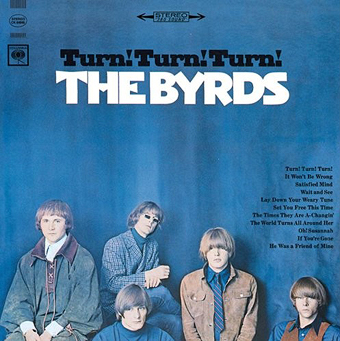
In late 1965, The Byrds released their second album “Turn! Turn! Turn!” At the suggestion of bassist Chris Hillman, the band recorded “Satisfied Mind.” The official title of the song was “A Satisfied Mind” and had been a number one country hit for Porter Wagoner in 1955. The song was also covered by other artists during the same period.
Red and Betty Foley peaked at #3 on the country charts and Jean Shepard charted at #4 on the same chart. Ella Fitzgerald was able to cross the record over to the pop charts where her single charted on the music sales charts at #25. Over the years, many artists released the song including Bob Dylan, Johnny Cash, Willie Nelson, David Allan Coe, Jeff Buckley, Tim Hardin, and others.
“Satisfied Mind” was an early excursion for The Byrds into the realm of country music that was four albums previous to their landmark “Sweetheart of the Rodeo” album in 1968. Gene Clark played the harmonica on this cut. The vocals were handled by Clark, Jim “Roger” McGuinn, and David Crosby.
“A Satisfied Mind” was written by Red Hayes and Jack Rhodes and was loosely based on the advice that his mother gave him. The title came from Hayes’ father-in-law who had stated the richest man in the world was the one with a satisfied mind.
I love this recording by Sister Rosetta Tharpe and although it predates my birth, it is worth inclusion here. Tharpe recorded “My Journey to the Sky” in 1948 and was released by Decca Records in the US and Brunswick in the UK as the flip side of “Up Above My Head.” The song features Sister Tharpe on lead vocals and a National Triolian guitar, Marie Knight on contralto harmony vocals, and the Sam Price Trio supplying the piano, bass, and drums. I do a version of this song based on Sister Rosetta's arrangement.
Mistakenly, the label lists Sister Rosetta Tharpe as the author of the tune; however, she was not. The song was written by Dorothy Austin of the Austin Gospel Singers of Toledo, Ohio. Austin dedicated the song to her grandmother, Mrs. Belle F. Woods. It was published in 1944 by the Austin Studio of Gospel Music whose rights were administered by Martin and Morris of Chicago. This predates Tharpe’s recording by four years – and the earlier date would have been significant had any litigation occurred to prove that Austin and not Tharpe was the author.
There are several scenarios that could have caused the misidentification of the song’s author. One, Decca Records may have assumed that the tune was a Tharpe original and applied the credit incorrectly. Second, Sister Tharpe could have stolen the tune outright and misrepresented herself as the author. Third, Sister Tharpe heard the song and performed it for a period of several years and actually believed she had written it.
Her version deviates slightly from the Austin original and it appears that she had heard the song and began performing it in her own style. The truth on the misidentification will probably never be known. Although Sister Rosetta’s guitar is present, it is difficult to hear. It is a great gospel recording nonetheless and worthy for inclusion as a Spiritual Sunday selection.
Being the fourth week of the month, Reading Between the Grooves features another record label. This month we feature Apple Records which was started as a creative outlet for The Beatles’ own recordings as well as for acts they had signed.
Non-Beatle releases (including the solo recordings of John, Paul, George, and Ringo) in the US were numbered sequentially with an 18XX numbering system (1800-1885); however, since The Beatles remained under contract with Capitol Records, their group releases retained Capitol catalog numbers. The label was initially active in the US from 1968 to 1975.
The label’s four initial singles were released simultaneously in the US on August 26, 1968. They included The Beatles’ “Hey Jude” (2276), John Foster & Sons Black Dyke Mills Band’s “Thingumybob” (1800), Mary Hopkins’ “Those were the Days” (1801), and Jackie Lomax’s “Sour Milk Sea” (1802).
While we featured Billy Preston’s live recording of “That’s the Way God Planned It” from “The Concert for Bangladesh,” we have not featured the single release from July 1969. Although Preston’s had a long term association with The Beatles and had been listed along with the Fab Four on the “Get Back” single, this was not enough to propel his debut single with the label into the Top 40. “That’s the Way God Planned It” only made it to #62 on the Hot 100.
It’s been a while since I had featured a Spiritual Sunday song. It wasn’t until recently that I discovered that Jon Faddis was the artist on “A Closer Look at A Closer Walk.” It was featured prominently in the Clint Eastwood film “The Gauntlet” and since I did a weekly jazz program, I stayed to the end of the credits trying to discover who the trumpeter was on this song. If Faddis was credited, I missed it.
I caught the title, but not the name of the artist as Jerry Fielding was listed as performer on all of the cuts. I saw the movie in Huntington, West Virginia in early 1978 and had forgotten about this cut until seeing the movie again several months ago. It is a great take on the old spiritual classic, “Just a Closer Walk with Thee.” This and a cup of coffee should get your Sunday moving.
By the way, the artwork for the movie poster and the soundtrack was done by one of my favorite artists: Frank Frazetta. I wrote about Frazetta and his contributions to the music world back in 2010 when he passed away.
Being that we have arrived at the fourth week of the month of February, we again feature a particular record label and some of its offerings during the next seven days. For this month, I’ve chosen to feature Stax Records out of Memphis, Tennessee. The label was a rebrand of Satellite Records that was founded in 1957. The name change occurred in 1961 and was an amalgamation of the surnames of its two owners, brother and sister Jim Stewart and Estelle Axton.
The label was poised for R&B history as prior to rebranding Satellite (and later Stax and its subsidiary Volt) signed a distribution deal with Atlantic Records. Stax signed and recorded the artists and Atlantic took Stax to a national audience. This arrangement lasted until 1967 when Atlantic was sold to the Warner Brothers/Seven Arts and Stax was relieved of its contract; however, all back catalog material that was distributed by Atlantic remained under that label.
In 1968, Paramount Pictures/Gulf+Western took ownership of Stax Records; however, Jim Stewart and Al Bell dissatisfied with the arrangement, bought Stax back in 1970. Bell bought out Stewart in 1972, and to make a long story short, the label had a multitude of problems including competing with its new distributor CBS Records. Stax declared bankruptcy in 1975 and Fantasy Records would later gain control of its current catalog, the unreleased masters, and the label’s brand.
From 1978-1981, Fantasy reinvigorated Stax and it had a limited amount of success both as a reissue label and a haven for new artists. In the 1980s, Fantasy was able to release alternate versions of the songs owned by Atlantic. Since these were different from the masters owned by Atlantic, Fantasy was able to release songs from Stax’s golden age without violating copyright laws. Stax would remain a reissue label until Fantasy’s new owner, Concord Music Group, fully reinvigorated the label in 2006.
One of the biggest hits of Al Bell’s era of Stax was released by The Staple Singers – “I’ll Take You There.” The song which alludes to heaven was sung by Mavis Staples and contrary to popular belief only features family members on vocals. Instrumentation was provided by the Muscle Shoals Rhythm Section and the Memphis Horns.
The guitar solo that is often credited to Roebuck “Pops” Staples was actually played by Eddie Hinton. Three other guitarists (Terry Manning, Jimmy Johnson, and Raymond Banks) all played on the cut. Manning also provided the harmonica and was an engineer on the song. “I’ll Take You There” was a #1 record on both the Hot 100 and the R&B charts. It vies with “Let’s Do it Again” as being the bands most popular recording.
This past Thursday, Cleotha Staples, the oldest of the five children of Roebuck "Pop" and Oceola Staples, died at 78 following nearly a decade battle with Alzheimer's disease.
Today’s Spiritual Sunday’s selection will be the last in that category for a while, as I am retiring the daily category. This is one of the two categories that have been around since the beginning of the blog and specifically it was the lowest ranked category by my visitors in the most recent survey. Beginning tomorrow with October 1, I am making some sweeping changes in our categories by eliminating the lower ranked categories.
While Tasty Licks Tuesday, One-Hit Wonder Wednesdays, Friday Flipsides, and Saturday’s Bubbling Under feature will remain; other days will change. Monday’s selection will become Media Monday and will be an extension of TV Thursday with the addition of songs from motion pictures. Thursdays will offer Thursday Repeats and Threepeats, and Sunday will give me an opportunity to feature a variety of music.
Our song today is a song of doubt and searching and is sung by the former lead singer of Ultravox, Midge Ure. The song is a prayer from an individual who does not have a relationship with a Supreme Being and is asking for various virtues.
Released in 1988 from his “Answers to Nothing” album, “Dear God” charted as a single in the US at #95; however, it did better on the specialized charts. It placed at #6 on the Mainstream Rock chart and at #4 on the Alternative Music chart. The song sounds like it could have been performed by his previous band Ultravox. The guitars, keyboards, and vocals are all handled by Ure.
Only three more posts are planned, but if you would like to see it continue, register your feelings at the survey found at http://tinyurl.com/8juv863.
I heard today’s Spiritual Sunday tune a few years back on Pandora and was reintroduced to it again about two months ago from the same source. “Drop Me Down” was a song originally performed by Charlotte based Lou Ford; however, Lou Ford was not an individual, but rather a band.
In 2006, another Charlotte based group, Tres Chicas recorded “Drop Me Down” for their CD “Bloom, Red, & the Ordinary Girl.” The three part harmonies of Lynn Blakey, Caitlin Cary, and Tonya Lamm are exquisite. While there is piano, drums, bass, fiddle, accordion, and guitar, nearly all the critics mention the organ that is the glue of the track. One going as far as saying it sounded like Garth Hudson of the band. I hear it too.
Other critiques of the sound compare it to a variety of musicians. Rick Cornell of IndyWeek.com stated, “Tres Chicas' folk-gospel take reveals the song to be a close relative of [Bob Dylan’s] ‘I Shall Be Released,’ with a soulfulness that seems to echo from the soundstage where The Band and The Staple Singers teamed up on ‘The Weight.’”
Thom Jurek of AllMusic adds, “The opening cut ‘Drop Me Down’ comes from the North Carolina band Lou Ford, and in Tres Chicas’ reading of it, could easily have been done by Gram Parsons & the Fallen Angels and Emmylou Harris with a gospel choir. To be truthful, it's devastatingly beautiful.”
Associate Provost and Professor of Mass Communication at Alderson Broaddus University and an adjunct faculty member at Southern New Hampshire University.
Graduate of Marshall University, West Virginia University, Southern New Hampshire University, Kentucky Christian University and Mountain State University.
Dissertation on institutional rebranding (see newriver.net) was the 2009 international winner of the Alice L. Beeman Dissertation Award for Outstanding Research in Communications and Marketing for Higher Education Advancement and was the 2008 Leo and Margaret Goodman-Malamuth Outstanding Dissertation Award for Research in Higher Education Administration.
Placed as a winner in five Active Industry Research Contemporary Hit Radio "Pick the Hits" competitions from 1983 through 1987. Each competition had 31 winners. Placed 2nd (1st among radio participants), 6th, 10th (twice), and 21st in the five competitions.
Awarded 14 gold & platinum records and an international sales award from various record companies. Winner of 30 Public Relations awards.