Showing posts with label Postmortem Panegyrics. Show all posts

Wednesday, October 25, 2017

Ain't That A Shame, Fats Domino Has Passed

Being busy today, I didn’t hear about Fats Domino’s passing until I returned to my office and saw a post by Rebekah Canada stating that October has been a “Lousy month.” Another great legend has been ushered off into eternity. “Ain’t that a Shame,” Fats Domino, 89, died of natural causes yesterday, October 24, 2017.


An innovator from the very beginning, Antoine Domino, was once called the “real king of rock ‘n roll” by Elvis Presley. In the 1950s, Domino was second only Presley in releasing a string of hits. When asked about this new “Rock ‘N Roll” sound in the 1950s that he helped to create, he stated that he’d been playing rhythm and blues for 15 years – which what rock ‘n roll really is.

His influence went far and wide, with “Ain’t that a Shame” being the first song John Lennon learned to play on the guitar. Paul McCartney later wrote “Lady Madonna” in the style of Fats Domino. Domino returned the favor by recording the tune, as well as “Lovely Rita” on his 1968 comeback LP “Fats is Back.”


“Ain’t that a Shame,” which was mistakenly credited as “Ain’t it a Shame” on the original Imperial Records’ releases was co-written by Domino and his long-time producer, Dave Bartholomew. It was a #1 R&B hit that crossed over to pop audiences and landed at the #10 position. Rolling Stone considered “Ain’t that a Shame” as one of the top recordings of the rock ‘n roll era.

We’ll miss you Fats – Rest in Peace.

Wednesday, October 4, 2017

Tom Petty: I Won't Back Down

It’s a few days since we got word that Tom Petty died at age 66; these were followed by alerts that it was a false report. Since being taken off life support, his demise was certainly eventual and he passed away on Monday, October 2, 2017 at 8:40 PM Pacific Daylight Savings Time at UCLA Medical Center. He had suffered a cardiac arrest and was found at his home on Sunday.


It seems as I get older, more and more of my heroes of the stage and screen, as well as family and friends, are passing away. This is a reminder of my own mortality – but with life comes death. As with Tom, it will be for all of us when our number is called.

I wasn’t an early follower of his music, but I must thank Dave Alley, who worked at West Virginia Public Radio in the 1970s, for alerting me of his musical genius. I remember particularly one afternoon Dave was making the argument that Tom Petty and the Heartbreakers were the musical descendants of one of my favorite groups, The Byrds.

I’ve been busy and couldn’t get to this tribute until tonight and am sorry I couldn’t post it sooner. Since it is a Wednesday, I thought an acoustic version of one of his hits – “I Won’t Back Down” is in order. Recorded live, the song comes off well with the organ being the only electric instrument on it. Listen for Mike Campbell’s mandolin parts. We’ll miss you Tom. Rest in peace.


Saturday, September 30, 2017

Monty Hall Has Chosen Door Number Three

It must be true, I read it on the Internet and people have posted it on Facebook. Monty Hall has chosen door number three and has entered into eternity. He passed away from heart failure at the ripe old age of 96 today. Since this is a music blog, how can the death of the host of TV’s “Let’s Make A Deal” be musically related? You’d be surprised.


Back in 1974, Steve Goodman and Jimmy Buffett collaborated on a song dealing with the effervescent and zany TV show “Let’s Make A Deal.” Both Goodman and Buffett recorded “Door Number Three” and I’ve chosen the latter’s version for our special tribute. Goodman's version, however, is somewhat lyrically different.


Appearing on Jimmy Buffett’s fifth album, “A1A,” “Door Number Three” was released as a single in July 1975 and peaked at 88 on Billboard’s Hot Country chart. The musicians were loosely arranged in a unit called the Third Coral Reefer Band.

Rest in Peace Monty – let’s hope you got the prize.

Monday, August 8, 2016

Carin' About B.E. Taylor

We interrupt our Second Week Special Week because B.E. Taylor passed away on Sunday, August 8, 2016. The 65-year old leader of the B.E. Taylor Group died from an inoperable brain tumor. Born in Aliquippa, PA as William Edward Taylor, the moniker B.E. came from his mother's nickname for the singer, Billy Eddie.


The B.E. Taylor Group was a Pittsburgh regional act that had minimal national success in the 1980s. Although not a national household name, he was well known in Western Pennsylvania, the Upper Ohio Valley, and North East Ohio. In their attempt at national stardom, The B.E. Taylor Group was signed to two major labels: MCA and Epic. Their most popular recording “Vitamin L” peaked at #66 on the Hot 100 and received considerable play on MTV in 1983 and 1984. Their first national release on MCA in 1982, “Never Hold Back,” charted at #54 on Billboard’s Mainstream Rock chart.

For today’s tribute, I’ve selected their third best known recording, “Karen.” Following their stint with MCA, they recorded “Karen” on the small and independent Breaker Records in 1984. When picked up by Epic Records, the band recorded the tune in 1986. “Karen” peaked at #94 on the Hot 100.


Over the years, he had worked for Nickelodeon and Nick at Night and had recorded commercials for Old Navy. In recent years, B.E. became known for his numerous charity concerts and annual Christmas shows. Rest in Peace B.E.

Sunday, March 13, 2016

A George Martin Production: Ultravox's Hymn

This last Tuesday, May 8, 2016, renowned record producer George Martin passed away at the age of 90. As most news outlets reported, Martin was best known in his role as the producer of all of The Beatles hit albums save one – “Let it Be.” Although Martin had produced most of the album’s singles and was the original producer on the fledgling album under the working title of “Get Back,” the band replaced him with Phil Spector for the final album release.


During the next week, I’ll be highlighting Martin’s production work. Yes, we’ll be featuring a Beatles’ song or two, but I want to concentrate on some of the other artists he produced. While his work with The Beatles stretched his creativity beyond comprehension, he is one of the best known producers of the 20th century.


One of the groups that he worked with was Ultravox in 1982. This new wave synth band of the 70s and 80s was barely known in the US. Charting at #61, their best selling US LP, “Quartet,” was the only album produced by George Martin. As the band was preparing to record “Quartet,” they sought a new producer and Martin’s daughter Lucy, an Ultravox fan, encouraged her dad to take the gig.


One of the single releases from “Quartet” was their tune “Hymn.” Loosely drawing from biblical language, the band produced what would be best termed as a psalm or song rather than a hymn despite the record’s title. The artwork for the picture disc and the single’s sleeve used Masonic emblems – go figure.  While “Hymn” was the band’s fourth most popular release in the UK and charted at #11, it failed to make a dent in the US charts. Ultravox’s only single to chart on the Hot 100 was “Quartet’s” previous single “Reap the Wild Wind,” which only made it to #71.

Enjoy this week of George Martin production and remember this man behind the music.

Saturday, March 12, 2016

RIP Keith Emerson: Take A Pebble

The musical world is reeling over yesterday’s untimely death of Keith Emerson from an apparent suicide. This great talent is now only with us through his recordings. My connection to Emerson came from my first hearing “Lucky Man” in 1970 on the radio and the band’s first two albums at my brother’s house in Lexington, Kentucky during the summer of 1971. Being a high school student on a limited budget, I settled for the “Lucky Man” single. The next year, I received as a gift “Five Bridges” by Emerson’s previous band – The Nice and purchased ELP’s single “From the Beginning.”


I had the opportunity to see ELP in concert during their “Works” tour on May 28, 1977 at the old Charleston, WV Civic Center. It was originally to be one of two consecutive shows in Cincinnati, but the first show was cancelled and Charleston became the venue for the 28th. Since it was a smaller hall than most of their shows that tour, there was no orchestra – just Emerson, Lake, and Palmer.

The Charleston show was festival seating and I sat down front and was quickly amazed at the pyrotechnics of Keith Emerson’s playing. Not only was he a fantastic musician, he was quite the showman. He attacked his keyboards with vigor – especially his Hammond organ – which he pulled down on himself several times during the night – never missing a note. He also used daggers to hold the keys down to create a drone sound.

A friend of mine who worked in a record store in Huntington, WV saw the Charleston show as well as the Cincinnati show on May 29 with the orchestra. She admitted the Charleston show was much more interesting. I know I enjoyed myself immensely.


To remember this great musician, I selected a song that features Keith Emerson on piano. Not only does it show his classical and jazz chops, he strums the grand piano in a prepared fashion twice during the tune. “Take a Pebble” is the second and longest cut on their debut album. This is one of my favorite album cuts by ELP.

Long live the music of the master of the keyboards: Keith Emerson.

Saturday, January 30, 2016

In Memory of Paul Kantner: We Can Be Together

Paul Kantner, another icon of rock ‘n roll, passed on Thursday, January 28. While some may not recognize his name, his influence was felt for many years as a founding member of Jefferson Airplane, Jefferson Starship, and the KBC Band.


Like many of the American rock performers of the mid to late 1960s, Kantner began as a folk singer in the vein of Pete Seeger. It was at one of these gigs that Marty Balin saw him and invited him to start a new band that became Jefferson Airplane. He eventually became the band’s leader. While he was not generally the front-person, he had the distinction of being the only member of Jefferson Airplane and its spinoff Jefferson Starship to appear on all of the albums by both groups.


Paul Kantner died in San Francisco from multiple organ failure and septic shock that occurred after having a heart attack. For our tribute to this seminal musician, I’ve selected the “B” side to the first single released from the 1969 LP “Volunteers”: “We Belong Together.” Kantner wrote the song and shared lead vocals with Grace Slick and Marty Balin. Thanks for the music, Paul, we’ll miss you.


Monday, January 18, 2016

Glenn Frey's Already Gone

The music world is still reeling from David Bowie’s death a week ago, and now the news has arrived about the untimely passing of Glenn Frey at the age of 67 in New York. The cause was rheumatoid arthritis, acute ulcerative colitis, and pneumonia. He was recovering from intestinal surgery.

Photo by Steve Alexander; used under license of Creative Commons.
While he trained as a pianist, Frey was better known as a guitarist who doubled on piano. His first recording was playing rhythm guitar and singing backup on Bob Seger’s “Ramblin’ Gamblin’ Man” in 1968. After touring with Linda Ronstadt in 1970, Frey, Don Henley, Randy Meisner, and Bernie Leadon formed the Eagles. Glenn sang a number of their hit records including today’s featured recording: “Already Gone.”


This 1974 hit was co-written by Jack Tempchin and Robb Strandlund. Tempchin and Frey would later team up to write a number of Frey’s solo hits. The lead guitar parts on “Already Gone” were supplied by both Frey and the band’s newest member, Don Felder. Although “Already Gone” only peaked at #32, it remains one of the Eagles’ better known songs.

Following the break-up of the band, he had a successful solo career with five Top 40 hits between 1982 and 1988. His last album was released in 2012 and departed from the styles he developed in the Eagles and as a solo artist. Laying aside his guitar and using only his voice as his instrument, “After Hours” was an album of standards and other songs in a similar vein.

I had the opportunity to meet Glenn on August 24, 1985 in Charleston, WV when he was opening for Tina Turner on her “Private Dancer” tour. While a number of radio programmers from four different markets were getting ready to meet him backstage, Glenn loudly called me by name “Jim, how on earth are you doing?” After giving me a big hug, he whispered in my ear, “I saw your name on your jacket. Just play along and we’ll make all of these other radio guys jealous.” After some banter he grabbed my hand and just started to dance. What you see below was caught on film by a friend. He was one of the most congenial stars that I’ve had an opportunity to meet.


The world has lost another great musical voice and we sadly pay our respects to Glenn Frey – Rest in Peace.

Monday, January 11, 2016

David Bowie: Fame

This morning on the way to work I heard the sad news of the passing of David Bowie due to cancer. It was just Friday that this same news outlet reported that it was Bowie’s 69th birthday as well as the day his new album “Blackstar” was being released. Too bad he never had the opportunity to see the success of his latest release.


As looking over the number of Bowie’s songs that I have featured on Reading between the Grooves over the years, I found nine – here are the links.

As a tribute to the life of David Bowie, this week I am going to feature more music by this late great rocker who changed musical styles throughout his career; what a trendsetter. For the initial post, it’s a #1 record from 1975: “Fame.” The songwriting credits went to Bowie, John Lennon, and Carlos Alomar.

While all three play guitar on the track, Alomar plays the funk parts. Lennon is doing the background vocals as well as engineering the tape loops that are found during the song. The beginning tape loop is a recording of several chords played backwards. Later, a backwards guitar is added to the mix. The final effects have Bowie’s voice recorded at various speeds and played back at normal speed. This not only changed the speed of which the word “Fame” was sung, but also the pitch of the playback as well.

“Fame” – what’s your name? Why, I think its David Bowie. Rest in peace Ziggy Stardust.

Saturday, January 2, 2016

The Unforgettable Natalie Cole has Passed

Since I didn’t turn the TV on yesterday, I didn’t learn about Natalie Cole’s death on New Year’s Eve until this morning. Over the years at the different formatted radio stations I worked and as a mobile DJ, I had the opportunity to play her music. She was always popular with the audience.


I grew up listening to Nat King Cole’s music at our home. He was one of my mother and dad’s favorite artists. So I was drawn to her smooth voice which matched her father only octaves higher. That led me to really enjoy her duet with her late father in 1991 on “Unforgettable.” It was nearly three decades since his death and modern technology allowed the marrying of the voices of this father/daughter pair. Smooth – it was smooth.


While “Unforgettable” was not her biggest hit, it at least made a sizable dent into three Billboard charts. Since it was an adult contemporary recording, it was natural that it placed at the #3 mark on the A/C charts. Since her primary chart success came on the R&B charts, it did well there peaking at #10 – even though it was not typical fare for this genre in 1991. Finally as she had five previous Top 10 singles on the Hot 100, it did well overall on this mainstream chart as it took the #14 slot.

While her dad had a hit with the song in 1951, it was originally recorded in mono. In 1961, Cole returned to the Capitol studios and re-recorded the song in stereo. It was this version from which his voice was extricated from the original tracks and a near perfect recreation of the Nelson Riddle arrangement was accomplished with current studio musicians. The primary instrumental difference was the addition of Pete Christlieb’s alto sax lead during the break. Nat’s parts were inserted along with his daughter’s voice to make an unforgettable performance.


“Unforgettable . . . with Love,” the tribute album of her father’s music, was a huge success selling over seven million copies and earning six Grammy awards in the process. “Unforgettable” specifically earned the Grammy for Record of the Year and the Grammy for Best Traditional Pop Performance. It was this genre of standards in which Natalie reveled and became her calling card for years to follow.

The 65 year old Natalie Cole died Thursday night at Cedar Sinai Hospital in Los Angeles “due to complications from ongoing health issues.” We’re sorry to see you part, but Natalie, you’ll always be a part of us – truly unforgettable. Rest in Peace.

Saturday, October 10, 2015

"Brite Eyes Don't Cry" - Robbin Thompson has Passed

I just heard a few minutes ago that Robbin Thompson passed away yesterday at age of 66. The Virginia rocker has been fighting the dreaded disease for 15 years. Personally, I hadn’t heard of Thompson until I moved to Southern West Virginia in 1981. His fan base was within the Southeast and he had a cult-like following especially in the Commonwealth. For those outside of the region, Virginians tend to view their state as the only commonwealth in the US, but it’s not.*


Although he was born in Boston and reared in Melbourne, Florida, Virginia became his adopted home in 1969 when he began attending Virginia Commonwealth University. In his early years, he fronted Bruce Springsteen’s Steel Mill band for a short period before embarking on a longstanding career as a solo artist and fronting his own ensemble, The Robbin Thompson Band.


Earlier this year, his and Steve Bassett’s song “Sweet Virginia Breeze” was signed into legislation to be one of Virginia’s official popular songs. This song was featured on 1980’s “(two b’s please),” an album that also contained “Candyapple Red” and “Brite Eyes” – his only song to become a minor hit in the US – although it and others were regional hits. We played all three of these selections as album cuts at WCIR-FM, as his popularity had even extended into our region – but not to the north of us.


The album was released regionally on a local label based in Richmond and was picked up by Ovation for national release after selling 200,000 units in Virginia, the Carolinas, and DC. I couldn’t find any chart information on “Brite Eyes” other than it debuted on Billboard’s Radio Play chart at #88 during the fall of 1980.

“Brite eyes don't cry – it’s gonna be alright – you know I hate to see you cry.” Rest in Peace Robbin.


*Pennsylvania, Massachusetts, Kentucky, Puerto Rico, and the Northern Mariana Islands are also commonwealths.

Monday, September 14, 2015

RIP REO's Gary Richrath

Gary Richrath is dead. While he may not have been a household name, he was one of the most underrated guitarists of the rock n’ roll era. Although he wasn’t the front man of REO Speedwagon, his impressive guitar licks always stood out on REO’s numerous LPs. While I met him twice, both were brief encounters and I never had an opportunity to really talk to him except to complement him on his work.


His death yesterday reminded of my own mortality as he is just a few years older than me. And although I have not been active with this blog, this sad news prompted me to attempt to reactivate “Reading Between the Grooves” for the second time this year.

I first heard Richrath’s licks during the fall of 1973 – Greg Rector placed his stereo speakers out the open window of his dorm room at Kentucky Christian College and I heard REO’s “Ridin’ the Storm Out” as it blared across campus. Penned by Richrath, “Ridin’ the Storm Out” is notable for the Moog synthesizer used on the cut, but you’ll also hear some of the greatest guitar work this side of Peoria.


While I featured “Ridin’ the Storm Out” in 2010 with several other REO classics, it was the studio version featuring Michael Murphy. The song was released as a single in 1973, but failed to chart. In 1977, a live version featuring Kevin Cronin was released as a single from “Live: You Get What You Play For.” While the tune charted, its peak at #94 wasn’t spectacular; however, Gary’s guitar work was; if you excuse the pun, its electrifying on this live version.

Gary – we’ll miss you – Keep “Ridin’ the Storm Out.”

Tuesday, March 3, 2015

Call it a Landmark or a Milestone, but Orrin Keepnews Crossed Over to the Riverside

You may not recognize his name, but Orrin Keepnews was a mover and a shaker in jazz. Unfortunately, Keepnews passed away on Sunday – one day before his 92nd birthday. In 1953, Keepnews and Bill Grauer founded one of the premier jazz record labels of the decade: Riverside A label that soon gave its rivals, Prestige and Blue Note, a run for the money. At Riverside, Keepnews handled record production while Grauer was in charge of business operations. When Grauer died in 1963, the label quickly folded.


Although Riverside ended in 1964, the label was a jumping off point for artists such as Cannonball Adderley, Theolonious Monk, Bill Evans, Wes Montgomery, and others. Although Riverside had dried up, Keepnews returned to the music business in 1966 with yet another new label: Milestone. By 1972, Fantasy Records acquired Milestone and the masters from Riverside, and Keepnews became Fantasy’s jazz A&R man.


Beginning in 1985, Keepnews launched yet another label: Landmark Records, which eventually was acquired by the Muse in 1993. Over the years, Keepnews was awarded four Grammys: two for production and two for the best liner notes.

In Orrin Keepnews’ honor, we’ll feature a cut from Wes Montgomery’s first album with Riverside. Although Montgomery had recorded two albums for Pacific Jazz, he was not under an exclusive contract with the label. Having heard Montgomery play in an Indianapolis club, Cannonball Adderley insisted that Keepnews sign him to Riverside. Keepnews flew from New York to Indianapolis where he eventually landed at the Missile Blues Club where Montgomery was playing his unique octave runs on the guitar.


In the wee hours of that morning in 1959, Keepnews signed Montgomery to an exclusive contract with Riverside – and the rest is history. Our featured selection is from the “Wes Montgomery Trio” LP: Montgomery’s interpretation of Theolonious Monk’s “Round Midnight” – the first cut on the album – an album produced by Orrin Keepnews.

While Keepnews has crossed over, his impact on jazz will remain indefinitely. Rest in peace.


Live Long and Prosper Leonard Nimoy

On Friday, February 27, 2015, Leonard Nimoy was jettisoned out of the Enterprise into the unknown. Although Nimoy at times was in odds with his Spock persona, he came to embrace the “Star Trek” role for which he was best known. Outside of jamming on the Vulcan lyre with “space hippies,” Nimoy was a recording artist in his own right.


Although best known as a TV star on “Star Trek” and “Mission Impossible,” Nimoy was also a recording artist. It was not unusual for actors in the 1960s to also be bifurcated into the role as musical performers. Nimoy’s recording contract was with Dot Records, which was owned by Paramount – the parent company of Star Trek’s producers’ Paramount Television (formerly known as Desilu Productions).


While none of Nimoy’s recordings were big sellers, I’ve decided to feature his first single release: “A Visit to a Sad Planet” – a recitation (with lots of reverb) over an ethereal backing track. It was released on the 1967 album, “Leonard Nimoy Presents Mr. Spock’s Music from Outer Space.” The album outperformed the single by a considerable amount. The album peaked at #83, while the single only made it to #121.

Although his recording career took a back seat to his acting, it is interesting to hear this recording after all these years. We’ll miss Spock as well as his soul – Leonard Nimoy. Live long and prosper.


Saturday, February 28, 2015

Mercury Records: It's Judy's Turn to Cry

Nearly two weeks ago, Mercury Records’ artist and hit maker from the early and mid 1960s, Lesley Gore passed away at the age of 68 from lung cancer. Born as Lesley Sue Goldstein, her family changed their surname to Gore at some point after her birth. When producer Quincy Jones was interviewed a number of years ago about Lesley Gore, he mentioned that he had misgivings about her surname Gore as being appropriate for a pop artist, but before he could suggest a pseudonym, Mercury had already released “It’s my Party” and it was climbing up the charts. Her family’s adopted name stuck.


With the success of “It’s My Party,” Jones had Gore returned to the studio and cut a concept album of “cry” songs and Mercury rush released the “I’ll Cry if I Want To” LP. One of the cuts was the follow-up to her initial 1963 hit – “It’s Judy’s Turn to Cry.” Both songs did very well. “It’s My Party” resonated with teenage girls and the song climbed to the #1 spot on both the Hot 100 and the Rhythm & Blues charts. “It’s Judy’s Turn to Cry,” while not performing as well as her initial single, was no slouch. The follow-up charted at #5 on the Hot 100 and at #10 on the R&B chart.

Gore would have subsequent hits, but unknown to most of her fans – the majority of these hits were not penned by Gore and were mostly written by men – short of shattering the somewhat early feminist leanings of this artist. While she didn’t write the majority of her hits – she sang them nonetheless and became a voice for girls and women everywhere.

Here’s a rundown on her Top 40 hits:

PEAKYEARSONGWRITERS
11963It’s My PartyHerb Weiner, Wally Gould, & John Gluck
21964You Don’t Own MeJohn Medora & David White
51963It’s Judy’s Turn to CryBeverly Ross & Edna Lewis
51963She’s A FoolBen Raleigh & Mark Barkan
121964That’s the Way Boys AreMark Barkan & Ben Raleigh
131965Sunshine, Lollipops, and RainbowsMarvin Hamlisch & Howard Liebling
141964Maybe I KnowJeff Barry & Ellie Greenwich
161967California NightsMarvin Hamlisch & Howard Liebling
271964Look of LoveJeff Barry & Ellie Greenwich
271965My Town, My Guy, and MeLesley Gore, Paul Kaufman & Bob Elgin
371964I Don’t Wanna Be A LoserBen Raleigh & Mark Barkan

Out of her 11 highest charting hit records, only one was co-written by Lesley Gore (“My Town, My Guy, and Me”). Two others were co-authored by females – and both were written by husband and wife team Jeff Barry and Ellie Greenwich. Only one of her bigger hits was completely composed by women: our feature, “Judy’s Turn to Cry.” Gore developed her songwriting craft and her largest contribution was aiding her brother Michael in composing the music for the motion picture “Fame.”

The world will miss this champion of women everywhere. Rest in Peace Lesley Gore.


Thursday, January 15, 2015

Missed 2014 Necrology: Mr. Acker Bilk

While some of the missed necrology from 2014 was just because I didn’t get around to authoring a post at the time, I completely missed other deaths. That includes the passing of Mr. Acker Bilk on November 2, 2014. He was 85 years old. Some may not remember the man with the bowler, goatee and strange name, but I do. His real first name was Bernard, but used the nickname “Acker,” which comes from his native Somerset, England dialect for friend.


The song “Stranger on the Shore” evokes fond memories of early summer 1962 when the single was released in the US and it quickly became a #1 record. In fact, it was only the second time a British artist had a number one record on this side of the Atlantic, and it had been ten years since Vera Lynn’s hit. “Stranger on the Shore” was certainly not the last record by a Brit to reach the top of the charts, and two years later it was quite a common occurrence.

Billboard named “Stranger on the Shore” as 1962’s record of the year; it was certified gold for selling in excess of a million copies. The keynote instrument is Acker Bilk’s clarinet. Bilk’s interest in this member of the woodwind family was spawned a friend’s gift of a rather rough, second-hand instrument. Having no reed, the friend fashioned one from a piece of wood. Acker Bilk later procured a better instrument and the rest is history.

Although billed as Mr. Acker Bilk and his Paramount Jazz Band, it doesn’t appear that the band was present on this recording. The backing instrumentation was provided by the Leon Young String Chorale. Both Bilk and Young were credited with writing the tune. Later, publisher Robert Mellin added lyrics to this already charming instrumental and vocalists could tackle “Stranger on the Shore.”


Wednesday, January 14, 2015

Missed 2014 Necrology: Jesse Winchester

When Jesse Winchester passed away in April 11, 2014, I didn’t get an opportunity to make a post concerning his passing. In our second week special on missed necrology from 2014, I’m finally getting around to posting a tribute. Winchester died in Charlottesville, Virginia 36 days before his 70th birthday.


One year after graduating from Williams College, Winchester received his draft notice and immediately fled to Canada where he stayed until receiving amnesty from President Jimmy Carter. Since leaving the US in 1967, he was not able to perform in the states until 1977 out of fear of arrest. His first stateside concert after gaining amnesty was in Vermont where he performed to sell out crowd.

Winchester never had as great a commercial success in the US as he did in Canada. This can largely be attributed to him not being able to support his releases with live performances on this side of the border. His biggest record in the US was “Say What” from his 1981 “Talk Memphis” LP. Nationally, the single charged at #32 and I had an opportunity to play it on the air. As a thank-you, Bearsville Records sent me a baseball style “Talk Memphis” tour jacket in 1981.

Unfortunately, I’m not featuring “Say What,” but a cut from his debut album. While his first release on Ampex Record in 1970 earned critical acclaim, it was a commercial failure in the US. The initial single, “Yankee Lady,” failed to chart in the US, but peaked at #20 on the Canadian pop chart and was a bigger adult contemporary hit at #8.


“Yankee Lady” was produced by Robbie Robertson of The Band who played guitar on the cut. He was joined by Levon Helm, a fellow member of The Band, who provided a nice mandolin track. Helm also played drums on the album, but since two other drummers are also credit, I am not sure which one appeared on “Yankee Lady.” Oh yeah, Todd Rundgren was the recording engineer as well. This is nice stuff from 1970.


Tuesday, January 13, 2015

Missed 2014 Necrology: Saul Zaentz Kant Danz

If you’ve noticed anything about this blog, 2014 it was more hit and miss than discussing the hits. Having reached the milestone of five years and over 1,500 posts, I decided to take some long breaks from writing due to changes in my personal life. Unfortunately by doing so, I missed reporting on a number of deaths that occurred in 2014. For January’s second week feature, I’ve decided to go back and highlight some of these individuals who passed during last year.


Today’s feature is not one that most individuals would place on a pedestal in the scheme of things, but he was essential to the music business no matter what your opinion was of Saul Zaentz. Having died on January 3, 2014 at the age of 92, Zaentz started his recording career as Fantasy Records’ national sales manager in 1955. By 1967, he and others had the opportunity to purchase the label from Max and Sol Weiss. The friction between Zaentz and the label’s biggest artist, Creedence Clearwater Revival, places him in the category of musical infamy.

A nascent CCR began recording for Fantasy under their original name Tom Fogerty and the Blue Velvets. However, before the singles were released, owner Max Weiss had changed their name to The Golliwogs. Unfortunately, their numerous recordings from 1964 to 1967 failed to reach national attention. That is until the band reinvented itself as Creedence Clearwater Revival in 1967. Their first recordings under that moniker were issued on Fantasy in 1968 – and the rest is history – so they say.

CCR’s contract with Fantasy stipulated that Zaentz and Fantasy owned the recording and publishing rights to all of their music. In order to divest himself from Fantasy, John Fogerty signed away further rights to Zaentz. Bad investments caused CCR to lose significant income and lawsuits to recoup some of the losses were marginally successful. In addition, Zaentz sued Fogerty for plagiarism of his own music claiming that 1984’s “The Old Man down the Road” borrowed from CCR’s “Running through the Jungle.” Fogerty won the case and countersued for legal costs with Fogerty ultimately winning.


When John Fogerty finished recording his landmark solo album “Centerfield” for Warner Brothers in 1985, he used it as a platform to voice his displeasure with Zaentz by recording “Mr. Greed” and “Zanz Kant Danz.” The prominent hook was “Zanz kant danz, but he’ll steal your money.” When Zaentz threatened a defamation of character suit, Fogerty rewrote, rerecorded, and reissued the song titled as “Vanz Kant Danz.” The second version was released as a promo single.


While I believe that Zaentz’s tactics in handling CCR and John Fogerty were deplorable, he had a major influence on the music business. To remember him in a light hearted way, here’s the Fogerty’s “Zanz Kant Danz.”


The Video of Vanz Kant Danz


Sunday, January 11, 2015

My Tribute to Andraé Crouch

On Thursday, January 8, gospel music great Andraé Crouch shuffled off this mortal coil and into the arms of his Savior. A catalyst for the contemporary Christian music scene, Crouch was not only an excellent musician, but he was a prolific songwriter. Many of Crouch’s compositions reached legendary proportions with first his own recordings of these songs, but also for the hundreds of cover recordings and their appearances in numerous hymnals and song books.


I had the opportunity to meet Andraé back in 1973 or 74 at the Huntington (WV) Memorial Field House. He was the first star I would have the pleasure to meet, and I still have the program with his autograph. Unfortunately, it is boxed away and finding it these days is next to impossible – but I saw it when we were packing before our last move. He was generous enough, however, to stay as long after the show as necessary to meet every one of his fans.

Groomed as recording artist by Ralph Carmichael, Crouch’s talent was as big as life itself and is illustrated by seven Grammys, six Dove Awards, and numerous other accolades he was accorded. Crouch wasn’t perfect, but he was forgiven. Unfortunately for us, he died five days after suffering a heart attack. He was 72.

Although bassist Bili Thedford sang lead on Crouch’s composition “My Tribute,” it is still a fitting song to remember Andraé’s contributions to Christian music. “To God be the glory for the things He has done.” Rest in peace, Andraé.


Monday, December 22, 2014

Cry Me A River as Joe Cocker Has Departed

I don’t often have two posts in a day, but when I do it is usually due to unfortunate news. Earlier today, I heard that 70 year-old Joe Cocker had succumbed from lung cancer. His death occurred in Colorado where he made his home. In 1968, he was propelled into the spotlight with his rendition of The Beatles’ “With A Little Help from my Friends.” While it was a number one record in Britain, it had a dismal showing in US where it only peaked at #68.


His appearance on the stage of Woodstock gained him further notoriety and he entered the Top 40 charts in the US. Some of his biggest hits included the following:
  • His rendition of another Beatles’ album cut, “She Came in through the Bathroom Window” that charted at #30,
  • A cover of The Boxtops number one record from 1967, “The Letter,” that reached #7 in 1970;
  • A rocking version of the 1950s torch song “Cry Me a River,” at #11;
  • His composition with keyboardist Chris Stainton, “High Time We Went,” that charted at #22;
  • A live re-issue of Dave Mason’s “Feeling Alright” that landed at #33. This version did significantly better than the 1968 studio rendition that charted at #69;
  • His cover of the Allman Brothers’ “Midnight Rambler” that landed at #27;
  • His most popular solo release that charted at #5 – “You are so Beautiful”;
  • A duet with Jennifer Warnes, “Up Where We Belong,” which became his most popular recording and was his only #1 record; and
  • His final Top 40 hit in the US, 1989’s “When the Night Comes.”

Although I am not featuring “Up Where We Belong,” I have a personal connection with this song. As the music director at WCIR-FM in Beckley, WV, I was one of the first programmers in the country to play the record on the air. It was immensely popular in our market; however, it took awhile for other stations to play the tune and for several weeks only a handful of reporting stations had added the song. My gut instinct was correct, and the record peaked at #1 for three weeks. It also won the both the Academy Award and the Golden Globe for “Best Original Song.”

Atlantic Records, who was distributing Island Records at the time, promised me a gold record if it sold a million copies. Unfortunately, the record sold slightly under a million and initially failed to have gold status. With sales of it as an oldies release, the Recording Industry Association of America certified the single both as gold and platinum in January 1989. By December that same year, the single was reissued; however, it failed to chart in the US the second time around.


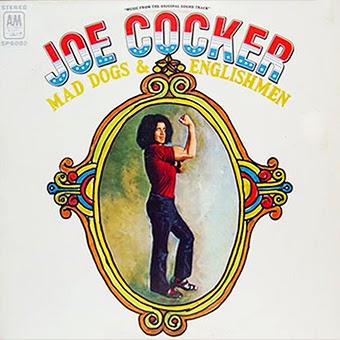
While I am not featuring this tune, I have decided to feature his rocking rendition of the torch ballad “Cry me a River.” Recorded live at the Fillmore East in New York in March 1970, “Cry me a River” was originally a slow tempo, sultry number until Cocker got a hold of it.


The album features a veritable who’s who of the music business. Most notably, Leon Russell is on piano, Don Preston on guitar, and Chris Stainton is playing a Hammond organ. This is a great recording and captures Cocker’s energy. I’ve never had the opportunity to see him live, but have seen his Woodstock footage as well as other videos – and he was the consummate (and very animated) performer. We’ll miss you Joe – Rest in Peace.