Showing posts with label Media Mondays. Show all posts

Monday, October 12, 2015

Rolling Clones: You Can't Always Get What You Want

Looking for unique versions of Rolling Stones’ songs has be somewhat of a challenge, but not an impossibility. One that is different from the original recording comes from the 2007 release of the “House M.D. Original Television Soundtrack.” Today’s Rolling Clones’ selection is the Band from TV’s recording of “You Can’t Always Get What You Want.”


Although the song as it appears on the CD was never featured in any episode, the Stones original was referenced several times throughout the length of the series. Hugh Laurie, who also played the lead role of Dr. Gregory House, sings lead as a member of Band from TV. This reggae influenced rendition is missing the choir, the acoustic guitar, and French horn that are characteristics of the original – but this remake has its own character that makes it very, very palatable.

Monday, September 28, 2015

The Lovin' Spoonful: Butchie's Tune

OK, I admit it. I have a problem. I am a binge-watcher. There, I said it. Since June 2014, I’ve been hogging my wife’s Netflix account to watch several programs that I hadn’t had the opportunity to see as of yet. I’ve seen most of the biggies and a few relatively unknowns. I find it easier to follow a series when I have the opportunity to watch it in sequence at my own time – whether that be at 11:00 PM or 5:00 AM.


Recently, I finished watching – well, let me backtrack, I finished watching all of the episodes on Netflix of “Mad Men.” The final seven episodes are not yet online – so, I’ll have to wait to see what happens. When the show originally aired on AMC, I only got to see two episodes – one from season two and one from season four. Without the prior context, I waited for Netflix to pick up the series.

What I’ve seen so far was pretty accurate for its portrayal of the 1960s. I did find some flaws and possible flaws in some of the artifacts – but really only minor ones that only someone with OCD would notice. One of the nice things about the show is that it provided a plethora of music from varying styles.

One of the tunes that caught my ear was the closing song of the 12th episode from season five. It is when Don Draper is driving Glenn Bishop back to the prep school and he allows Glenn to drive his car. The song, “Butchie’s Tune,” was by The Lovin’ Spoonful and was an album cut off their “Daydream” LP from 1966.

Although cowritten by John Sebastian and bassist Steve Boone, the lead vocals were supplied by drummer Joe Butler who still tours as Joe Butler and The Lovin’ Spoonful. One of the shining moments of “Butchie’s Tune” is the countrified guitar licks of Zal Yanovsky who had the pedal steel type Sus4 chords down pat.


Monday, March 9, 2015

The Many Shades of Leon Russell: This Masquerade

You may remember the Top 10 hit that George Benson had with “This Masquerade” in 1976. Did you realize that it was a Leon Russell composition that he recorded originally for his “Carney” LP in 1972? Additionally, the song got into the hands of a number of folks that didn’t buy the album but purchased Leon’s highest charting single: “Tightrope.”


I was one of the latter and “This Masquerade” was the flip side of “Tight Rope.” Although the single edit was mixed differently than the album version which is heard here. Instead of the esoteric instrumentation at the song’s beginning lasting 1:22, the single version started directly with Leon’s vocal track.


In addition to George Benson’s hit version, “This Masquerade” was recorded by Helen Reddy, The Carpenters, Shirley Bassey, Willie Nelson, David Sanborn, Robert Goulet, Kenny Rogers, and a host of others. Benson’s hit version won the 1977 Grammy for Record of the Year as well as being nominated for two other Grammy award categories.


Leon’s version also was featured in two movies from 2006: “Bug” and “The Pursuit of Happyness.” This qualifies Leon’s version to also be our Media Mondays’ selection. Of all of Leon’s compositions, “This Masquerade” probably provided him the most income in the form of royalties. Great stuff from 1972.


Tuesday, March 3, 2015

Live Long and Prosper Leonard Nimoy

On Friday, February 27, 2015, Leonard Nimoy was jettisoned out of the Enterprise into the unknown. Although Nimoy at times was in odds with his Spock persona, he came to embrace the “Star Trek” role for which he was best known. Outside of jamming on the Vulcan lyre with “space hippies,” Nimoy was a recording artist in his own right.


Although best known as a TV star on “Star Trek” and “Mission Impossible,” Nimoy was also a recording artist. It was not unusual for actors in the 1960s to also be bifurcated into the role as musical performers. Nimoy’s recording contract was with Dot Records, which was owned by Paramount – the parent company of Star Trek’s producers’ Paramount Television (formerly known as Desilu Productions).


While none of Nimoy’s recordings were big sellers, I’ve decided to feature his first single release: “A Visit to a Sad Planet” – a recitation (with lots of reverb) over an ethereal backing track. It was released on the 1967 album, “Leonard Nimoy Presents Mr. Spock’s Music from Outer Space.” The album outperformed the single by a considerable amount. The album peaked at #83, while the single only made it to #121.

Although his recording career took a back seat to his acting, it is interesting to hear this recording after all these years. We’ll miss Spock as well as his soul – Leonard Nimoy. Live long and prosper.


Tuesday, February 24, 2015

Mercury Records: Mighty Quinn

Loosely based on Anthony Quinn’s performance as an Inuit named Inuk in the 1960 film “The Savage Innocents,” the official title of Bob Dylan’s composition was “Quinn the Eskimo (Mighty Quinn).” Although Dylan recorded a demo the song with The Band in 1967, he did not release a recording of the song until 1970 when a live version appeared on the “Self Portrait” LP. The rendition that most folks remember, however, is the 1968 hit by Manfred Mann.


While Manfred Mann’s #1 UK release on Fontana Records was consistently named “Mighty Quinn,” this was not the case for the American version on Mercury Records. Not only did the US release have a plethora of label styles from variety of pressing plants, the song’s title varied as well. Mercury releases of the tune in 1968 are listed as “Mighty Quinn (Quinn the Eskimo),” “The Mighty Quinn (Quinn the Eskimo),” and “Quinn the Eskimo.” The US version charted at #10.


Manfred Mann’s version featured Mike d’Abo on vocals, Manfred Mann on keyboards, Mike Hugg on drums, Tom McGuinnes (later of McGuinnes Flint) on guitar, and Beatles’ friend Klaus Voorman on bass and flutes. Mann and Hugg were the only two original members of the band that remained in 1968.


Despite the fact that the album did not include “By Request – Edwin Garvey,” the flip side of “Quinn the Eskimo (Mighty Quinn),” the UK album was titled “Mighty Garvey!” The US LP release was more appropriately named “The Mighty Quinn.”


Monday, February 9, 2015

The Many Shades of Leon Russell: Jumpin' Jack Flash/Youngblood

Although Leon Russell’s piano, songwriting, and arranging had been all over the music charts in the 1960s, I had never heard of him until I saw “The Concert for Bangladesh” in 1971. I was blown away by his energy, his prowess on the keyboard, and that gravelly voice. And what a voice it is – he has one of the most unmistakable vocal styles that has had the opportunity to hit the American airwaves.


While Leon is showcased on George Harrison’s “Beware of Darkness” on one verse, he is pure Leon on a medley of The Rolling Stones’ “Jumpin’ Jack Flash” and the Jerry Leiber, Mike Stoller, and Doc Pomus classic “Youngblood.” I always loved that song – I had the original single by The Coasters on ATCO; it was flipside of their hit “Searchin’.” I didn’t think anyone else could do it or “Jumping Jack Flash” justice until I heard Mr. Russell perform this medley.

Some of Leon’s “Shelter People” appear on this recording. The additional lead vocals are provided by Don Preston who also plays guitar on this medley. Additionally, bassist Carl Radle is on this cut – his only performance on the album. Other “Shelter People” include Jesse Ed Davis on guitar, Jim Keltner on drums, and back-up vocalists Claudia Linnear and Don Nix. A large cast of other great musicians, such as Billy Preston on Hammond organ, supported Leon and his crew. I wish the live film footage was available on YouTube, but sadly it’s not.


Monday, December 22, 2014

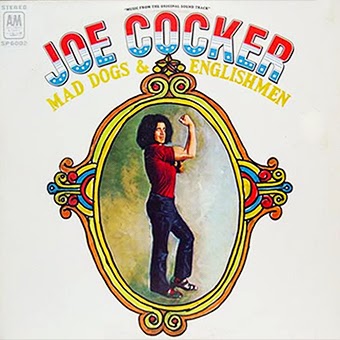
Cry Me A River as Joe Cocker Has Departed

I don’t often have two posts in a day, but when I do it is usually due to unfortunate news. Earlier today, I heard that 70 year-old Joe Cocker had succumbed from lung cancer. His death occurred in Colorado where he made his home. In 1968, he was propelled into the spotlight with his rendition of The Beatles’ “With A Little Help from my Friends.” While it was a number one record in Britain, it had a dismal showing in US where it only peaked at #68.


His appearance on the stage of Woodstock gained him further notoriety and he entered the Top 40 charts in the US. Some of his biggest hits included the following:
  • His rendition of another Beatles’ album cut, “She Came in through the Bathroom Window” that charted at #30,
  • A cover of The Boxtops number one record from 1967, “The Letter,” that reached #7 in 1970;
  • A rocking version of the 1950s torch song “Cry Me a River,” at #11;
  • His composition with keyboardist Chris Stainton, “High Time We Went,” that charted at #22;
  • A live re-issue of Dave Mason’s “Feeling Alright” that landed at #33. This version did significantly better than the 1968 studio rendition that charted at #69;
  • His cover of the Allman Brothers’ “Midnight Rambler” that landed at #27;
  • His most popular solo release that charted at #5 – “You are so Beautiful”;
  • A duet with Jennifer Warnes, “Up Where We Belong,” which became his most popular recording and was his only #1 record; and
  • His final Top 40 hit in the US, 1989’s “When the Night Comes.”

Although I am not featuring “Up Where We Belong,” I have a personal connection with this song. As the music director at WCIR-FM in Beckley, WV, I was one of the first programmers in the country to play the record on the air. It was immensely popular in our market; however, it took awhile for other stations to play the tune and for several weeks only a handful of reporting stations had added the song. My gut instinct was correct, and the record peaked at #1 for three weeks. It also won the both the Academy Award and the Golden Globe for “Best Original Song.”

Atlantic Records, who was distributing Island Records at the time, promised me a gold record if it sold a million copies. Unfortunately, the record sold slightly under a million and initially failed to have gold status. With sales of it as an oldies release, the Recording Industry Association of America certified the single both as gold and platinum in January 1989. By December that same year, the single was reissued; however, it failed to chart in the US the second time around.


While I am not featuring this tune, I have decided to feature his rocking rendition of the torch ballad “Cry me a River.” Recorded live at the Fillmore East in New York in March 1970, “Cry me a River” was originally a slow tempo, sultry number until Cocker got a hold of it.


The album features a veritable who’s who of the music business. Most notably, Leon Russell is on piano, Don Preston on guitar, and Chris Stainton is playing a Hammond organ. This is a great recording and captures Cocker’s energy. I’ve never had the opportunity to see him live, but have seen his Woodstock footage as well as other videos – and he was the consummate (and very animated) performer. We’ll miss you Joe – Rest in Peace.


Liberty Records: Summertime Blues

It’s the day after the beginning of winter in the Northern Hemisphere and here I am featuring a song about summer. But Eddie Cochran’s iconic record about summer break is appropriate, as it was a Top 10 hit for Liberty Records – our feature label during this month of December. Released initially as a “B” side, Liberty saw the potential of this song and flipped it to the “A” side in August 1958. This was a good move as “Summertime Blues” peaked at #8 in September – well after summer break ended.


Written by Cochran and his manager Jerry Capehart, the song features Cochran on all of the guitars and vocals, Connie “Guybo” Smith on bass, and Earl Palmer on drums. It is believed that the handclaps were provided by Cochran and his fiancée Sharon Sheeley; however, there is no official documentation to confirm this hypothesis.

With the death of his friends Buddy Holly, Richie Valens, and J.P. Richardson (The Big Bopper), Cochran had a premonition of an early death. Unfortunately, this was the case as he met his untimely end at the age of 21. Cochran was the only one of the four occupants to have fatal injuries in a one-vehicle accident in England.

Travelling at a high rate of speed, the taxi in which he was a passenger slammed into a lamp post. Cochran was thrown from the taxi and died the next day in St. Martin’s Hospital in Bath. It is said he was protecting Shelley as the crash was imminent. Shelley was a prolific songwriter and later would be co-creator of the Shindig TV show.


As for Cochran, his guitar playing would influence several generations of musicians. He was best known sporting an orange Gretsch 6120 hollow-body electric guitar. Cochran was an innovator of sorts as he customized his instrument. Wanting a fatter sound than the stock DeArmond Dynasonic pickups, he replaced the neck pickup with a Gibson P-90 (as seen in the photo above).

While “Summertime Blues” doesn’t include any lead guitar parts, Cochran replaced the typical wound “G” string with an unwound version that made string bending easier. It is also reported that he tuned the guitar a step lower (DGCFAD) on occasion to facilitate the bending of the strings.

“Summertime Blues” has been covered numerous times, but most notably by Blue Cheer in 1968 (peaking at #14), The Who in 1970 (#27), and Alan Jackson in 1994. Jackson’s version charted at #104, but was a #1 country tune. None, however, has had the success of the original on Liberty.  Cochran’s original recording also appears on the soundtrack to “Caddyshack.”


Tuesday, December 9, 2014

Parts of Speech: I Me Mine

Oops, I was so busy yesterday, I missed my Monday post. I’ll double up and make good on it later this week. Our look at parts of speech brings us to personal pronouns – and especially first person, personal pronouns in the subjective, objective, and objective possessive cases. Recorded in early January 1970, George Harrison’s “I Me Mine” was one of the last tunes recorded by The Beatles.


A demo was recorded by George in 1969; however, when the film “Let it Be” was being assembled from the various film clips of the “Get Back” (the original title of the “Let it Be”) project, director Michael Lindsey-Hogg wanted a better version of the tune to use while showing John Lennon and Yoko Ono dancing a waltz. The original waltz was filmed as George was introducing the song to the band.

This required a re-recording of the tune on January 3, 1970. This was after John Lennon had left the band and only included the other three members. With 16 takes, an abbreviated version of the song was recorded by Harrison, McCartney, and Starr. George sang lead and harmony vocals and played acoustic and electric lead and rhythm guitars; Paul added harmony vocals and played bass, organ, and electric piano; and Ringo added drums – to which he overdubbed another drum track on April 1, 1970.

When Phil Spector was assembling the “Let it Be” album, he lengthened the original by splicing a copy of the song into itself. Additionally, Spector added an orchestral arrangement that included 18 violins, four violas, four cellos, three trumpets, three trombones, and a harp. The song had two movements – the verse in A minor that was in 6/8 time, and the chorus in A major in 4/4 time. During the chorus, George and Paul actually sing “I, Me, Me, Mine.”


The lyrics were based on a Hindu doctrine of renouncing one’s own ego to achieve enlightenment. Harrison also used “I Me Mine” as the title of his autobiography. Although the “Let it Be” album bore the Apple label and logo on the American releases, it was actually distributed by United Artists, who had the rights to the film. To my knowledge, the red Apple label was only used in the US, as releases in other nations (including Canada) used the traditional green Apple label.

When Capitol’s parent company EMI purchased United Artists in 1978, it provided an opportunity for two Beatles’ LP controlled by United Artists, “A Hard Day’s Night” and “Let it Be,” to finally be issued on the Capitol imprint in the US.


Monday, November 3, 2014

Cris Jacobs: The Devil or Jesse James

A few weeks ago, I heard our feature artist on Mountain Stage doing a number of songs including today’s selection, “The Devil or Jesse James.” In fact, I heard it twice with an encore presentation a week later. As I was listening to the show, Jacobs’ impressive guitar work caught my ear. From Baltimore, Jacobs had been a member of the band The Bridge until they officially called it quits in 2011.


Besides one reunion date with The Bridge in 2012, Jacobs has been performing solo and with his own band – which is appropriately called the Cris Jacobs Band. It’s hard to tell exactly what tuning that Jacobs is using on this cut, as his fingers are often obscured by the microphone. My best guess is that it is a Double Dropped “D” Tuning (DADGBD) that is capoed up a full step to “E.”

This version was recorded on February 23, 2014 as part of the webcast “Listen in with Ellen Cherry.” Nice stuff.


Monday, October 27, 2014

Elektra Records: Istanbul (Not Constantinople)

The inspiration for using Elektra Records as this month’s feature was inspired by today’s song by They Might Be Giants. In early September I was making my weekly trek to my current position when I heard a National Public Radio’s Morning Edition story on a new crime novel set in old Byzantium. The author and the reporter briefly discussed the various names of what is now Istanbul. The story closed with They Might Be Giants’ rendition of “Istanbul (Not Constantinople).”


Although known as Constantinople (and Byzantium before that), the name Istanbul is not a recent fabrication. Istanbul has been used for centuries as it is a corruption of the Greek phrase “εις την πόλιν (eis ten polin)” meaning “into the city.” The song, however, commemorates Turkey’s 1930 request that global postal authorities only use the name “Istanbul” and cease using “Constantinople.”

Written 23 years after the fact in 1953 by Jimmy Kennedy and Nat Simon, the song was a hit for The Four Lads. The original charted at #10 and was certified gold. Keeping the swing arrangement, They Might Be Giants’ 1990 remake is a little more raucous than the original and its faster tempo makes it a perfect vehicle for They Might Be Giants’ unusual style. The fiddle also adds to the overall flavor of this version.

They Might Be Giants took their name from the title of a 1971 quixotic film starring George C. Scott and Joanne Woodward. The title was a reference to Cervantes’ character Don Quixote’s belief that the windmills he was fighting were actually giants.

Unlike the original, the remake of “Istanbul (Not Constantinople) only charted at #61; however, it is better known as album cut from TMBG’s third LP, “Flood.” Of their 16 albums, “Flood” was the only one to be certified as platinum in the US.


Monday, October 13, 2014

Tenor Guitar: For You Blue

For our second installment regarding the tenor guitar we turn to George Harrison’s son Dhani and his rendition of his father’s composition from The Beatles’ “Let it Be” album. The Gap utilized this 12-bar blues for one of its 2013 commercials.


Dhani plays a Gibson EST-150 electric archtop tenor guitar on this cut. From the pickup and the headstock decal, it appears that this particular guitar was manufactured in the late 1940s or early 1950s. Dhani uses an open “D” tuning (D-F#-A-D) on this cut and it lends itself quite well to the feeling on this song.

Additionally, there is a slide guitar on this tune playing similar to the lap guitar that John Lennon played on the original. Aaron Embry, who also plays tenor guitar and piano, plays on this cut but I am not sure which instrument(s) he is playing. I would venture that he is emulating Paul McCartney’s piano track. McCartney put paper in the strings to get the honky-tonk sound.

Dhani doesn’t typically play his father’s tunes because of the automatic comparison. The unmistakable resemblance in looks and sound to his dad makes you wonder if he inherited any DNA from his mother.


Gap Commercial


Monday, September 22, 2014

Chrysalis Records: Eyes Without A Face

Day Two of our look at Chrysalis Records takes us back to 1984 with Billy Idol’s first Top 10 hit in the US. Co-written by Idol and guitarist Steve Stevens, “Eyes without a Face” pays homage to the 1960 French horror film “Les Yeux Sans Visage,” which was released in the US under the title of “The Horror Chamber of Dr. Faustus.” “Les Yeux Sans Visage” can be translated as “Eyes without a Face”


The film’s inspiration on the writing of “Eyes without a Face” is additionally noticeable with the backup vocals sung by Perri Lister. Throughout the song, Lister sings “Les yeux sans visage.” While sometimes considered a soft rock track, “Eyes without a Face” dispels this proposition with the searing guitar work from Steve Stevens.  While the guitar break is excellent, it is Judi Dozier’s keyboards and Idol’s voice that make this cut spectacular.

As the second of four singles issued from the “Rebel Yell” album, “Eyes without a Face” was the highest charting cut from the LP. It peaked on the Hot 100 at #4 and placed almost as high on the Rock chart where it placed at #5. As expected, “Eyes without a Face” failed to chart very high on the Dance chart and only made it to #63. It’s inclusion on this chart was probably due to Idol’s previous success on this specialty chart with “Dancing by Myself,” “Mony Mony,” and “White Wedding.”


Monday, September 15, 2014

eden ahbez: Full Moon

You may not know eden ahbez’s name, but if you heard Nat King Cole’s recording of “Nature Boy,” you’ve heard one of his compositions. Considered to be the original “hippie,” ahbez believed that only “God” and “Infinity” should be the only words in the English language that are capitalized – and hence we use lower case letters in our reference to him.


Ahbez, who was the personification of “Nature Boy,” lived in the woods with his family. It is said that they camped just below the first “L” in the famous “Hollywood” sign in Los Angeles. They only ate fresh vegetables, fruits, and nuts. Since he had long hair, a beard, and wore a white robe and sandals before such appearances became common in the late 1960s, his persona was similar to the many artistic depictions of Jesus.

Although he wrote “Nature Boy” in the late 1940s, ahbez did not begin recording his own music until 1959. He recorded a number of singles and one album: “Eden’s Island: The Music of an Enchanted Isle.” Today’s selection, “Full Moon,” was featured in the TV show “Fargo.” “Full Moon” is reminiscent of the recordings of Martin Denny with the addition of beatnik poetry.

Not my normal fare, but interesting as a piece of recording history. Enjoy.


Monday, September 1, 2014

Amy Ray: Duane Allman

I must apologize for my extended absence. I just started a new job and I needed to concentrate on becoming acclimated to my new surroundings during the last two weeks. To get back into the “Grooves,” I have a performance that I heard a few months ago on Mountain Stage from West Virginia Public Radio.


Luckily, Amy Ray’s tribute to “Duane Allman” was videotaped and immortalized on YouTube. Amy plays what appears to be a vintage Gibson A model mandolin. The song really presents an authentic Allman Brothers’ vibe with the interplay between the lead guitar and the pedal steel. Unfortunately, neither musician is featured much visually in this recording; however, the talented fiddle player gets more than his share of screen time.

If Amy Ray’s name is not familiar, perhaps you’re familiar with the Indigo Girls. Amy and Emily Saliers have been performing since the early 80s in that unit. Ray has additionally recorded five studio and two live albums as a solo artist. Good stuff.


Monday, August 4, 2014

Foster the People: Best Friend

For our “Media Monday” selection, I go back a May episode of the David Letterman Show when Foster the People performed “Best Friend.” I remember sitting in my apartment in Kentucky watching the show. I was mesmerized by their performance.


A couple of things drew me to this song. One was the chorus of kids singing the background. They really added greatly to the presentation. They also looked like they were having a blast.


Another aspect of the song that I liked is that it was reminiscent of some of the dance music coming out of Britain in the 1980s. It evoked memories of ABC, The English Beat, Spandau Ballet, and Level 42. Plus, Cubbie Fink is playing a late model Dan Electro bass – a man after my own heart. I have two vintage Dan Electros: a 6 and a 12-string.


Studio Version


While I prefer the live version – which is a switch for me – here’s the studio recording from Foster the People’s 2014 CD “Supermodel.” The single charted at #119 on the Hot 100, #15 on the Alternative chart, #21 on the Hot Rock chart, and #22 on the Rock Airplay chart.

Foster the People is technically a trio and all of the other musicians are sidemen. Besides Fink, the other two official members are lead vocalist Mark Foster (who also plays keys) and drummer Mark Pontius.


Monday, July 28, 2014

J-Man and Keith: 20th Century Boy

Back from a short vacation, I’m ready to rock with “Reading Between the Grooves.” Since today is my father’s birthday, I’ve picked a song that was used in Verizon’s Father’s Day commercial from last month.


Sounding a great deal like T-Rex’s 1973 original recording of “20th Century Boy,” the cover by J-Man and Keith captures the soul of Marc Bolan. The cut was released just weeks before Father’s Day in May 2014.


Original Recording from T-Rex

The original T-Rex recording was originally issued only as a single and did not appear on CD until 1994 when it was added as a bonus track to the 1973 album “Tanx.” The single did quite well in Europe; however, I cannot find any documentation that it was released as such in the US. If it was, it failed to chart.


Monday, July 14, 2014

Tommy Ramone Was A Punk Rocker

By the time The Ramones hit the music scene, I had just come off from a long association with progressive rock and had moved into listening to jazz and fusion. The Ramones and other punk rock bands were not my cup of tea at the time; however, I learned to appreciate their simplistic style that invoked their rock ‘n’ roll roots. As Tommy Ramone is credited as saying, their choice of music was “hugely influential blasts of short, aggressive, cartoonishly fast songs.”


Born in Budapest, Hungary as Erdélyi Tamás – a name which he also reversed as Thomas Erdelyi before taking the stage surname Ramone. The Ramone moniker was chosen by the band because Paul McCartney had previously used the pseudonym Paul Ramon early in his career.

Last Friday, Tommy Ramone – the last remaining original member of the band – passed away from bile duct cancer at the age of 65. Because of his disdain for touring, Ramone left his post as the band’s drummer in 1979 shortly after the release of their third album, “Rocket to Russia.”

Ramone served as drummer on the band’s first three albums and the 2003 live release of “NYC 1978.” After leaving the band, he served as producer on 1979’s “It’s Alive” and co-producer of 1984’s “Too Tough to Die.” To add to his resume, Ramone/Erdelyi served as an assistant engineer on Jimi Hendrix’ “Band of Gypsies,” Hendrix’s only album for Capitol Recrods.


To honor the last living original Ramone, I have selected “Sheena is a Punk Rocker” from the last studio album with Tommy Ramone as drummer. It was their second highest charting single; as it placed at #81 on the Hot 100. The song also appeared in the movie “Pet Sematary.”

Rest in Peace Tommy – you’ll be missed.


Monday, June 23, 2014

Amy Records: Working In The Coal Mine

Not long ago, I featured Devo’s remake of Lee Dorsey’s classic hit of “Working in the Coalmine.” Written by New Orleans legend Allen Toussaint, Dorsey took “Working in the Coalmine” to the #8 slot on the charts and it became the most popular record on Amy Records. In addition to its success on the Hot 100, “Working in the Coalmine” peaked at #5 on the R&B chart.


Part of the production of the song was the use of an authentic pick axe as a percussive instrument. Allan Toussaint was all over this 1966 recording. Not only did he write the tune, he arranged the song and co-produced the single with Marshall Sehorn – his business partner in Tou-Sea Productions and Marsaint Music. “Lord, I’m so tired. How long can this go on?” Oh, about 2 minutes and 45 seconds. Enjoy this classic from Amy Records.


In addition to being used in several motion pictures, Lee Dorsey’s hit was also used in a 1991 Blaupunkt Audio commercial. Here’s the ad.


Monday, June 16, 2014

Casey Kasem: The End of Our Road

While his health has been failing, the world lost a broadcast legend yesterday when Casey Kasem passed away at the age of 82. In addition to being the voice of “Shaggy” on Scooby-Doo, Kasem was best known for his role of initiating and hosting American Top 40. I first got familiar with Kasem and his show by listening to his broadcast on WKEE in Huntington, WV in the mid 1970s.


Although I worked in radio for 20 years, I never had the opportunity of working for a station that hosted AT 40. It was a sign of honor in a market to be the American Top 40 affiliate. Casey hosted the show from July 4, 1970 to August 6, 1988. While he went on to host other shows after that, he returned to AT 40 from March 28, 1998 to January 3, 2004.


When American Top 40 debuted on Independence Day 1970, Kasem only had eight affiliates. The first record that he played was Marvin Gaye’s “The End of Our Road.” Gaye’s remake of Gladys Knight and the Pips’ 1968 hit peaked at 40. It was Kasem’s first record on the show and would be the first record he would play the following week as it stalled again at 40 before dropping off the chart.

The title of this Marvin Gaye single is a fitting end to a life that touched so many. It’s “The End of Our Road.” Rest in Peace, Casey; Rest in Peace.