Our final look at Chess Records takes us back to a cut by one of the premier bluesmen from the 20th century – Howlin’ Wolf – although sometimes he is identified on records as “Howling Wolf.” Born as Chester Burnett, the Wolf was larger than life – a big man with a big voice and a big personality to match. His six foot three, 300 pound frame was not to be reckoned with by anyone.
If you’ve seen “Cadillac Records,” you’ll recall Howlin’ Wolf (played by Eammon Walker) basically putting Leonard Chess in his place. Chess backed down. Whether the encounter was historically accurate or not, it certainly could be imagined as actually happening.
One of his non-charting singles – in fact most, if not all of his singles, failed to chart – was the blues classic “Spoonful.” Penned by bassist and Chess employee Willie Dixon, “Spoonful” is a Chicago blues standard and became better known to a wider audience when Cream recorded it for the UK version of their debut album “Fresh Cream.” It did not appear on the US version of “Fresh Cream” being replaced by the single “I Feel Free,” which was absent from the UK issue. It was, however, issued as a single by ATCO in the US. But, I digress.
Howlin’ Wolf recorded it first in 1960 and provides the inspiration for most rock interpretations of the song.
Howlin’ Wolf’s rendition wasn’t, however, the only version by a Chess artist. In 1961, Etta James and Harvey Fuqua did more of an R&B take on the song. Not as sparse as Howlin’ Wolf’s interpretation, Etta and Harvey’s duet features a full orchestra conducted by Riley Hampton who also wrote the arrangement.
Different than Howlin’ Wolf’s original, Etta and Harvey’s version includes a key change and an alteration of the lyrical content as well as the chordal structure of the tune. While Howlin’ Wolf’s version is centered on one chord, Etta and Harvey’s version includes a number of chord changes. At the chagrin of most blues aficionados, the second Chess release did better on the charts. It peaked at #78 on the Hot 100 and at #12 on the R&B charts.
Saturday, December 28, 2013
Friday, December 27, 2013
Chess Records: To Love, To Love
One of the biggest hits for the Chess Records label was Billy Stewart’s unique take on George Gershwin’s “Summertime” in 1966. The Single peaked at #10 on the pop charts as well as at #7 on the R&B charts. In fitting with our typical Friday Flipside’s theme, we present the “B” side of that single “To Love, to Love.”
Although missing his scat technique used on the “A” side and other recordings, “To Love, to Love” is a typical example of a Stewart ballad. Although he had been performing since he was 12 years old, Bo Diddley is credited with discovering Stewart and helped the young singer get a contract with Chess Records.
“To Love, to Love” was a collaboration of three men named Billy: Stewart the artist, Nichols the writer, and Davis the producer. In addition to its release year of 1966, the single was sequentially numbered as 1966 as well.
Although missing his scat technique used on the “A” side and other recordings, “To Love, to Love” is a typical example of a Stewart ballad. Although he had been performing since he was 12 years old, Bo Diddley is credited with discovering Stewart and helped the young singer get a contract with Chess Records.
“To Love, to Love” was a collaboration of three men named Billy: Stewart the artist, Nichols the writer, and Davis the producer. In addition to its release year of 1966, the single was sequentially numbered as 1966 as well.
Thursday, December 26, 2013
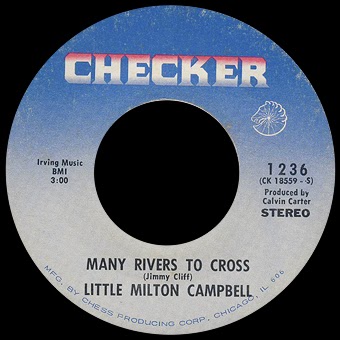
Chess Records: Many Rivers To Cross
Although Jimmy Cliff wrote and recorded his magnum opus “Many Rivers to Cross” in 1969, his version failed to make a dent in the US and UK charts; however, today, his rendition is the one for which most people are familiar. Within a year of Cliff’s release, James Milton Campbell (AKA Little Milton) recorded probably one of the first covers of the tune.
Little Milton came to the stable of Chess recording artists first as an independent record label owner of Bobbin Records which was distributed by Chess subsidiary Checker Records. He later translated back as an artist for Checker where he released a number of singles including his version of “Many Rivers to Cross.”
This recording is perfect for a Thursday Repeats and Threepeats selection, as Little Milton’s version of this song was reissued as a single in 1976. The occasion was the release of All Platinum Records’ Chess Blues Master Series. Not only was this series a shot in the arm for the label, it brought back a number of Chess artists to public light in the mid 1970s.
Besides Little Milton, the series included Howlin’ Wolf, Muddy Waters, Lowell Fulson, J.B. Lenoir, Little Walter, Sonny Boy Williamson, and Jimmy Rogers. Each album had a unique cover by the same artist and they really make a nice collection. Unfortunately being a starving college student, I had to wait until the albums were cut out and I only got three of the series – one being Little Milton’s collection.
More of a soul and R&B artist rather than a strict bluesman, I found Little Milton’s inclusion in the series a refreshing alternative. I was not familiar with Milton’s recordings before this as he had limited Top 40 airplay. Only two other artists had greater success with the song than Little Milton and Jimmy Cliff: Nilsson recorded the tune in 1974 and his version peaked at #109 and Annie Lennox charted at #80 in 2008.
Although many others have recorded the “Many Rivers to Cross,” I prefer Little Milton’s soulful rendition of this classic. Incidentally neither issue of Milton's recording charted.
Little Milton came to the stable of Chess recording artists first as an independent record label owner of Bobbin Records which was distributed by Chess subsidiary Checker Records. He later translated back as an artist for Checker where he released a number of singles including his version of “Many Rivers to Cross.”
This recording is perfect for a Thursday Repeats and Threepeats selection, as Little Milton’s version of this song was reissued as a single in 1976. The occasion was the release of All Platinum Records’ Chess Blues Master Series. Not only was this series a shot in the arm for the label, it brought back a number of Chess artists to public light in the mid 1970s.
Besides Little Milton, the series included Howlin’ Wolf, Muddy Waters, Lowell Fulson, J.B. Lenoir, Little Walter, Sonny Boy Williamson, and Jimmy Rogers. Each album had a unique cover by the same artist and they really make a nice collection. Unfortunately being a starving college student, I had to wait until the albums were cut out and I only got three of the series – one being Little Milton’s collection.
More of a soul and R&B artist rather than a strict bluesman, I found Little Milton’s inclusion in the series a refreshing alternative. I was not familiar with Milton’s recordings before this as he had limited Top 40 airplay. Only two other artists had greater success with the song than Little Milton and Jimmy Cliff: Nilsson recorded the tune in 1974 and his version peaked at #109 and Annie Lennox charted at #80 in 2008.
Although many others have recorded the “Many Rivers to Cross,” I prefer Little Milton’s soulful rendition of this classic. Incidentally neither issue of Milton's recording charted.
Wednesday, December 25, 2013
Chess Records: Love For Christmas
Because the soul group the Gems only produced regional hits for Chess Records, they are often overlooked in the history of the genre. One notable aspect of the Gems is that their lead singer was Minnie Riperton. Riperton later rose to fame in 1975 with the #1 hit single “Lovin’ You.” At the time she joined the all-girl group, Riperton served as the receptionist at Chess.
Written by producer Billy Davis, “Love for Christmas” was released for Christmas 1964, and like the band’s other singles, it failed to gain any national recognition. Arranger Phil Wright borrowed generously from the Motown sound for this single. I particularly like the tubular bells used throughout the song, but featured prominently during its intro.
Tuesday, December 24, 2013
Chess Records: Run Rudolph Run
Although Chess Records had a number of Christmas themed songs, the best known holiday classic on the label was by Chuck Berry’s “Run Rudolph Run.” Released in November 1958, the single peaked that Christmas season at #69.
The interesting aspect of this song was that the writing credits were listed as C. Berry Music and M. Brodie. In this case, C. Berry Music was a pseudonym for Johnny Marks, who along with Marvin Brodie, penned the tune.
Marks’ name was probably eliminated so that R&B radio would play the tune. Marks is known for writing a number of Christmas classics that included “Rudolph the Red-Nosed Reindeer,” “I Hear the Bells on Christmas Day,” “Rockin’ Around the Christmas Tree,” “Holly Jolly Christmas,” and dozens of others.
In addition, the Chess releases listed the publisher of the song as its own in-house publishing concern: Arc Music, BMI; however, the song was actually administered by St. Nicholas Music, ASCAP – the company owned by Johnny Marks.
The interesting aspect of this song was that the writing credits were listed as C. Berry Music and M. Brodie. In this case, C. Berry Music was a pseudonym for Johnny Marks, who along with Marvin Brodie, penned the tune.
Marks’ name was probably eliminated so that R&B radio would play the tune. Marks is known for writing a number of Christmas classics that included “Rudolph the Red-Nosed Reindeer,” “I Hear the Bells on Christmas Day,” “Rockin’ Around the Christmas Tree,” “Holly Jolly Christmas,” and dozens of others.
In addition, the Chess releases listed the publisher of the song as its own in-house publishing concern: Arc Music, BMI; however, the song was actually administered by St. Nicholas Music, ASCAP – the company owned by Johnny Marks.
Monday, December 23, 2013
Chess Records: Going Home
Unlike Muddy Waters’ sparse recordings of the 40s and 50s, Chess Records teamed Mr. Morganfield with a full band that contained electric guitar, amplified harmonica, piano, bass, drums, organ, saxophone, and back-up vocalists. The instrumentation and arrangement makes this 1962 recording a real gem.
By just listening to Muddy Waters’ canon of recordings from this period, you get a sense of the recording genius of the Chess brothers. They were far ahead of the competition and it is no wonder that The Rolling Stones travelled all the way from the UK just to record at 2120 South Michigan Avenue.
“Going Home,” which was later titled “Goin’ Home” for his 2002 CD “Goin’ Home: Live in Paris 1970,” is the epitome of a great slow Chicago blues number that showcases one of the founding fathers of the genre. In addition, the harmonica accompaniment and tenor sax solos are absolutely wonderful.
By just listening to Muddy Waters’ canon of recordings from this period, you get a sense of the recording genius of the Chess brothers. They were far ahead of the competition and it is no wonder that The Rolling Stones travelled all the way from the UK just to record at 2120 South Michigan Avenue.
“Going Home,” which was later titled “Goin’ Home” for his 2002 CD “Goin’ Home: Live in Paris 1970,” is the epitome of a great slow Chicago blues number that showcases one of the founding fathers of the genre. In addition, the harmonica accompaniment and tenor sax solos are absolutely wonderful.
Sunday, December 22, 2013
Chess Records: Diggin' My Potatoes
It’s the fourth week of the month and this week we’ll feature selected cuts from Chicago’s Chess Records. As the successor to the Windy City’s Aristocrat Records, Chess was formed in 1950 by brothers Leonard and Phil Chess. The label became America’s premier blues and rhythm and blues outlet and featured artists such as Howlin’ Wolf, Muddy Waters, Chuck Berry, Sonny Boy Williamson, Gene Ammons, Memphis Slim, Etta James, and many more.
In 1969, the Chess brothers sold the label to the GRT Corporation and it eventually served as a subsidiary of Janus Records – our last month’s feature. In 1975, All Platinum Records purchased Chess and had some limited releases of old material that were issued with the help of Leonard Chess’ son Marshall; he had previously run the label as its president in 1969 after it was purchased by GRT.
When All Platinum ran into financial difficulties, the masters were sold to MCA in the mid 1980s. MCA, now Universal Music Corporation, continues to hold the masters and periodically reissues old Chess material.
Not only did Chess record numerous artists out of its location at 2120 South Michigan Avenue in Chicago, they also produced recordings for Sam Phillips’ Memphis Recording Service. Phillips’ Sun Records would later become famous for recording Elvis Presley, Johnny Cash, Jerry Lee Lewis, Roy Orbison, and Carl Perkins.
When Chicago’s Premier Records declared bankruptcy in 1953, Chess purchased the masters and released these songs on the Chess imprint. One of these recordings was by Washboard Sam who was backed by Big Bill Broonzy on guitar. Although not a Chess recording, “Diggin’ my Potatoes” was a 1953 Chess release.
Sam, whose real name was Robert Brown, has previously recorded for the Bluebird and Vocalion labels prior to moving to Premier which would be released on Chess. A later compilation of his material was issued by Folkways. Washboard Sam died of heart disease in 1966.
In 1969, the Chess brothers sold the label to the GRT Corporation and it eventually served as a subsidiary of Janus Records – our last month’s feature. In 1975, All Platinum Records purchased Chess and had some limited releases of old material that were issued with the help of Leonard Chess’ son Marshall; he had previously run the label as its president in 1969 after it was purchased by GRT.
When All Platinum ran into financial difficulties, the masters were sold to MCA in the mid 1980s. MCA, now Universal Music Corporation, continues to hold the masters and periodically reissues old Chess material.
Not only did Chess record numerous artists out of its location at 2120 South Michigan Avenue in Chicago, they also produced recordings for Sam Phillips’ Memphis Recording Service. Phillips’ Sun Records would later become famous for recording Elvis Presley, Johnny Cash, Jerry Lee Lewis, Roy Orbison, and Carl Perkins.
When Chicago’s Premier Records declared bankruptcy in 1953, Chess purchased the masters and released these songs on the Chess imprint. One of these recordings was by Washboard Sam who was backed by Big Bill Broonzy on guitar. Although not a Chess recording, “Diggin’ my Potatoes” was a 1953 Chess release.
Sam, whose real name was Robert Brown, has previously recorded for the Bluebird and Vocalion labels prior to moving to Premier which would be released on Chess. A later compilation of his material was issued by Folkways. Washboard Sam died of heart disease in 1966.
Subscribe to:
Posts (Atom)