Sunday, November 30, 2014

Vee-Jay: Uncloudy Day

Well, we have one more day in November, so I thought I’d extend our look at Vee-Jay Records one more time. Like its cross town rival Chess, Vee-Jay also signed a number of gospel artists in addition to its cadre of blues and R&B artists. One of those acts was The Staple Singers. While Vee-Jay wasn’t their first label (that was United) and it wasn’t the label of their greatest success (that would be Stax), this family band had a modicum of notoriety when they were with Vee-Jay.


One of their top sellers at the label was the 1956 recording of “Uncloudy Day.” As with most singles in the 50s, the song was released both as a 78 RPM single and as a 45 RPM single. Eventually, the 78 market diminished and was overtaken by 45 RPMs as the medium of consumers’ choice for a variety of reasons – but primarily for fidelity reasons.


“Uncloudy Day” features Roebuck “Pops” Staples and his four children: Cleotha, Purvis, Yvonne, and Mavis. “Pops’” guitar, with the amp’s tremolo turned up, is the sole instrument on this recording. “Uncloudy Day” is a loose adaptation of Josiah Alwood’s 1885 composition “Unclouded Day.” Over 90% of the original’s lyrical content is missing and the arrangement is as far away from the original as possible. This truly is a Staples’ song, by and by.


Saturday, November 29, 2014

Vee-Jay Records: Bright Lights, Big City

Day Seven of our journey through Chicago’s Vee-Jay Records catalog and we bring you a little 12-bar blues by the legendary Jimmy Reed. Although one of Reed’s most popular numbers, “Bright Lights, Big City” only charted at #58 on the Hot 100. The song had a better showing on the R&B chart where it peaked at #3.


Recorded and released by Vee-Jay in 1961, the song features a duet between Reed and his wife Mary – who is otherwise known as “Mama” Reed. In addition to vocals, Reed plays a wicked high register harmonica lead in the key of “A” blues. Playing the harp, I’ve never mastered this upper register playing, but Reed certainly did.

Besides Jimmy and Mama Reed, it was truly a family affair as their son Jimmy, Jr. also plays guitar. Other musicians include second guitarist Lefty Bates, drummer Earl Phillips, and an unknown bassist. The Rock and Roll Hall of Fame recognizes “Bright Lights, Big City” as one of the 500 songs that shaped rock ‘n’ roll.


Friday, November 28, 2014

Vee-Jay Records: The Shoop Shoop Song (It's In His Kiss)

When Betty Everrett first heard “The Shoop Shoop Song (It’s in His Kiss)” she was unenthused about it, as she thought was childish; however, it was one the bigger records of her career. It was only eclipsed by one other recording: her duet with Jerry Butler on “Let it be Me.” “The Shoop Shoop Song” peaked on Billboard’s Hot 100 at #6, but was a #1 R&B record according to Cashbox.

One of several Vee-Jay label versions in use in 1964.
This one used a black Tollie label blank,

The song is reminiscent of the girl groups that had grown in popularity since 1962. Everett was backed by the Chicago group the Opals who performed on a number of Vee-Jay recordings. Although she had the most popular version of the tune in the 1960s, Everett was not the first to record the song.

Merry Clayton’s Original

A year earlier, Capitol Records released the song first recording of the tune by Merry Clayton who was backed by The Blossoms. The legendary Jack Nitzsche wrote the arrangement for Clayton.


While Clayton’s and Everett’s vocal arrangements are similar, the instrumental treatments are quite different. Later, Clayton would best be known as a backup vocalist for The Rolling Stones.

Ramona King’s Version

Released a week before Everett’s single in February 1964, Ramona King’s version on Warner Brothers stood to provide the most competition for Vee-Jay. This particular version was quite different from Clayton’s original and Everett’s treatment – it is almost Spectoresque in its arrangement and production.


King, who was formerly of the Fairlanes had previously recorded several sides for Lee Hazelwood’s Eden Records, was relatively unknown both then and now.


To combat any confusion with King’s release, Vee-Jay made the bold move to alter the song’s name. Both Clayton’ and King’s singles were issued with the original name Rudy Clark’s song: “It’s in His Kiss.” Vee-Jay decided to make the actual title parenthetical and accentuate the back-ups vocals of the Opals by calling the record “The Shoop Shoop Song (It’s in His Kiss).”

While neither Clayton’s nor King’s version charted, Betty Everett put “The Shoop Shoop Song (It’s in His Kiss)” on the musical map. While Clayton and Everett both had stronger voices than King’s, Vee-Jay’s arrangement of the song was far superior to the two previous renditions of the song. The instrumental punctuation, the horns reminiscent of Perez Prado’s orchestra, and the clever use of a xylophone as a lead instrument make Everett’s version a standout recording.


Thursday, November 27, 2014

Vee Jay Records: Thank You Girl

Happy Thanksgiving and today’s selection is the reason I picked Vee-Jay Records as our fourth week label feature. “Thank You Girl,” which was originally titled “Thank You Little Girl,” was an effort for The Beatles to thank their female fans. They hoped that each of these young ladies would consider the song as being a personal message of gratitude. The recording featured John Lennon on double tracked lead vocals and Paul McCartney on the high harmony. Additionally, it was the first recording by group to feature double tracked vocals. The song took 13 takes to complete and features harmonica overdubs by John Lennon.


The Beatles’ “Thank You Girl” appeared as a flip side on not one, but two Vee-Jay single releases by The Beatles. When Capitol Records passed on The Beatles in 1963, the masters of their first album, “Please Please Me” in the UK, were leased to Chicago based Vee-Jay Records. Prior to Beatlemania hitting America by storm in 1964, Vee-Jay released two singles: “Please Please Me”/”Ask Me Why” and “From Me to You”/”Thank You Girl.” The latter was released in the US on May 6, 1963. Since The Beatles were yet an unknown commodity in North America, “From Me to You” only charted at #116.

Once the floodgates were opened with the #1 release of “I Want to Hold Your Hand” on Capitol,” Vee-Jay began ramping up their Beatles product and beat Capitol to the punch with the first American Beatles’ LP, “Introducing The Beatles,” on January 10, 1964. Capitol followed with “Meet the Beatles!” ten days later.

Although the album titles and covers were different, “Introducing The Beatles” and “Please Please Me” had much in common including track order. There was one major difference; the UK version had more songs. Like all of the UK releases through “Revolver,” “Please Please Me” was no exception, as it contained two additional cuts that were eliminated from the American release. “Please Please Me” and “Ask Me Why,” which had been previously issued in early 1963 as the first Beatles’ Vee-Jay single, were not on the initial release of the album.

As Vee-Jay was trying to quickly capitalize on the new found fame of The Beatles before their license expired, “Introducing The Beatles” was repacked several times. The first reissue replaced “Love Me Do” and “P.S. I Love You” with “Ask Me Why” and “Please Please Me.” This was due to a restraining order from Beechwood Music, Capitol’s publishing arm, who had not licensed these two songs yet in the US.


During 1964, Vee-Jay issued other albums featuring the material from “Introducing The Beatles.” These included “Jolly What! England's Greatest Recording Stars: The Beatles and Frank Ifield on Stage” (which was later repacked as “The Beatles and Frank Ifield on Stage”); “Songs, Pictures and Stories of the Fabulous Beatles”; “The Beatles vs the Four Seasons”; and an EP, “Souvenir of Their Visit to America.” The two versions of the Beatles/Frank Ifield album was misleading as all of the tracks were studio recordings – four by The Beatles and eight by Ifield.

Additionally, Vee-Jay flooded the market in 1964 with additional Beatles’ singles. These included the following:
  • “Please Please Me”/“From Me to You,”
  • “Ask Me Why”/“Anna” (promo only),
  • “Twist and Shout”/“There’s A Place” (on Vee-Jay subsidiary Tollie Records),
  • “Do You Want to Know a Secret”/“Thank You Girl,”
  • “Love Me Do”/“P.S. I Love You” (on Vee-Jay subsidiary Tollie Records),
The second release of our feature tune was as the “B” side to “Do You Want to Know a Secret.” This single was released on March 23, 1964 and did quite well as a double sided hit. “Do You Want to Know a Secret” peaked at #2, while “Thank You Girl” made it to #35.


The record was certified gold for sales in excess of a million copies. Because Vee-Jay was overwhelmed in pressing Beatles’ records, numerous label variations exist for all of the releases. The one shown above is a Tollie yellow blank used for this particular issue. Black blanks, also used for Tollie releases, were used as well.


To make one last stab at sales before Vee-Jay’s license expired in October 1964, the label issued four Vee-Jay/Tollie singles on their subsidiary Oldies 45. “Do You Want to Know a Secret” and “Thank You Girl” were issued with the lowest catalog number of the four simultaneous releases.

True Stereo Version

While the Vee-Jay issues were either mono or rechanneled stereo, a true stereo version of “Thank You Girl” was issued by Capitol on “The Beatles’ Second Album,” which was released on April 10, 1964. In addition to being a true stereo mix, this version of “Thank You Girl” contains additional harmonica parts during the song’s bridge and at the end.


Capitol added extra reverb to the vocals its North American album release of “Thank You Girl.” To me the reverb is a bit over-the-top considering that the wet signal was in a different channel than the dry signal, and that sounds a bit odd at times. Since this was a different mix, Capitol may have sidestepped Vee-Jay’s rights to the song.


Following the expiration of Vee-Jay’s license, eleven of the songs from “Introducing The Beatles” were issued by Capitol on “The Early Beatles” in March 1965. One year following Vee-Jay’s last minute issue of four singles on their Oldies 45 label, Capitol issued six singles by The Beatles in their Starline Series of oldies singles.


While in the 70s and 80s, all of The Beatles’ singles were issued with the Starline imprint, these six releases were the only Starline Series Beatles’ records in the 1960s. Similar to the standard yellow/orange Capitol swirl label, the original Starline Series releases were in a two-tone green swirl.

Of the 12 songs released on the Starline label, 10 of these had appeared previously as Vee-Jay recordings. While the first four had the same configuration as the Oldies 45 singles, two additional singles were issued: “Roll over Beethoven”/“Misery” and “Kansas City”/“Boys.” If you notice on the Vee-Jay releases, the songwriting is credited to McCartney-Lennon rather than the more common configuration of Lennon-McCartney that was used thereafter.

The song fulfills several duties today.  Because it is an expression of thanks, we make it our Thanksgiving holiday song.  It also charted in the 30s, so it is our Thirty Something Thursday release.  Finally, since it was released multiple times, it fits the bill as our Thursday's Threepeats and Repeats selection. Hope you enjoy both versions. 


Wednesday, November 26, 2014

Vee-Jay Records: Raindrops

One of Vee-Jay’s more popular releases was inspired when Dee Clark was driving through a heavy rainstorm. As the protagonist, Clark uses the excuse of raindrops to cover up the fact that he is actually crying because his lover had left him. Released in 1961, “Raindrops” peaked at #2 on the Hot 100 and #3 on the R&B chart.


The production of this song was well ahead of its time. Part of this could be attributed to Riley C. Hampton’s arrangement. Hampton, who was a noted Chicagoland string arranger, worked on a number of recordings produced in the city. One his better known arrangements was Etta James’ “At Last.” Like Clark, Hampton was a native Arkansan who traveled north to Chicago to make his mark on the music business.

While Dee Clark had six Top 40 hits between 1958 and 1961, “Raindrops” was his biggest song and his final hit record.


Tuesday, November 25, 2014

Vee-Jay Records: Boom Boom

When I think of John Lee Hooker’s 1961 recording of “Boom Boom,” the movie “The Blues Brothers” comes to mind, as Hooker appears singing the tune while Jake and Elwood Blues get ready to enter the Soul Food Café. Released in 1962, the original charted both on the R&B and Hot 100 charts. On the R&B side, it peaked at #16; however, it failed to make it into the Top 40 by only peaking at #60.


The sidemen that accompanied John Lee Hooker’s guitar and vocals are a veritable who’s who of session musicians. The Funk Brothers of Motown Records’ fame provided the backing. Included among the band were the following musicians: Joe Hunter on piano, James Jamerson on bass, Benny Benjamin on drums, Larry Veeder on guitar, Hank Cosby on tenor sax, and Mike Terry on baritone sax.

Hooker said that he was inspired to write the song from a female Detroit bartender. Since Hooker was frequently tardy for his gigs at the Apex Bar, the barkeep would say, “Boom, boom – you’re late again.” Hearing the phrase enough, he was inspired to write the song.

Cameo in The Blues Brothers


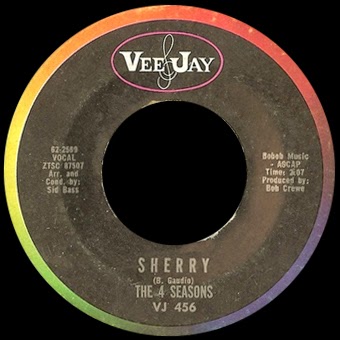
Vee-Jay Records: Sherry

While The Four Seasons had released a number of regional singles, the boys from Jersey had immediate success when they signed to Vee-Jay Records in 1962. Their first release on the label, “Sherry,” was also their first #1 record. If I am correct, “Sherry” was also the second #1 single for the label.


It took The Four Seasons’ keyboardist/vocalist Bob Gaudio 15 minutes to write “Sherry” and it may have been the best spent quarter hour in Gaudio’s life. Originally known as “Jackie Baby” after First Lady Jackie Kennedy, Gaudio cycled through about a half dozen names before settling on “Sherry” for its eventual title.

Gaudio admitted that the idea for “Sherry” wasn’t totally original. It was inspired by Bruce Channel’s 1961 hit “Hey Baby.” Not only did “Sherry” make it to the #1 slot on the Hot 100 for five weeks, it also peaked at #1 on the R&B charts. This early Four Seasons’ hit was produced by musical legend Bob Crewe.